It’s snowing massively in Copenhagen on the night that Isa Genzken’s long-anticipated exhibition World Receiver opens at Den Frie Centre of Contemporary Art. From far down the street, a moon set atop a thick steel pole gleams through the whiteout: Genzken’s Vollmond (Full moon, 1997–2023), installed outside the gallery since 2025, prefiguring what is to come. The strange lamppost’s synthetic glow is a romantic promise of a city that never sleeps.
Copenhagen does, in fact, seem a little intoxicated by Genzken’s presence. An hour before the exhibition, I’m meant to meet a friend at a bar, but he arrives an hour early. “Omg, I’m so messy I’m here an hour too early haha. Wtf, this show fucks with my brain,” he texted. The hype has been unavoidable. The woman is clearly an icon – the primordial mother of junk art, historically indispensable – and, not least, a crucial reference for a new wave of sculpture by young artists in the Nordics. Her way of absorbing and aestheticising contemporary culture, then tipping it on its head, is a strategy echoed in the work of Tora Schultz, Esben Weile Kjær, coyote, Lina Lundqvist, Jack Elmgren, Klara Zetterholm, Elmer Blåvarg, Nicole Walker, and others, all of whom – in different keys – turn late-stage capitalist logic inside out by borrowing, amplifying, and distorting its symbols.
Somehow, Genzken always feels ultra-contemporary. I remember thinking how cool it all was when I first encountered her work in 2016, at her solo show Mach Dich hübsch! (Make Yourself Pretty!)at Martin-Gropius-Bau in Berlin. Her practice mirrored precisely the kind of art I was drawn to then, with its sharply ironic critique of commerce and consumption. Paint-smeared jackets on hangers in straight rows and all those fucked-up mannequins went so well with Telfar Clemens, Anna Uddenberg, and Simon Fujiwara at the 9th Berlin Biennial in 2016, curated by DIS, jocularly flaying reality and propping it (slightly askew) up on a pedestal. Nefertiti busts in sunglasses and extensions belonged, in my mind, to post-internet art’s habit of digging into the canon. With digital models and slick plastic knock-offs of Greek statues and museum artefacts – think Kate Cooper, Oliver Laric, Claudia Mate – discourse around authenticity and aura accompanied an effort to insert all these strange new works in an art-historical lineage. Genzken felt perfectly aligned with the period’s fashionable ambivalence: a simultaneous disgust with and affection for consumer culture. She could call the present out while embracing it at the same time.
At Den Frie, ten years after DIS’s Berlin Biennial, I don’t feel the same cheeky urgency to make big claims about “our time.” Maybe it’s because the whole exhibition feels like a collapse of timelines as I move through a landscape shaped by the artist’s compulsively hoarding gaze. Sometimes, memory fragments seems almost violently yanked from their contexts. Like in the first room, where segments of an airplane fuselage have been turned into four wall pieces.
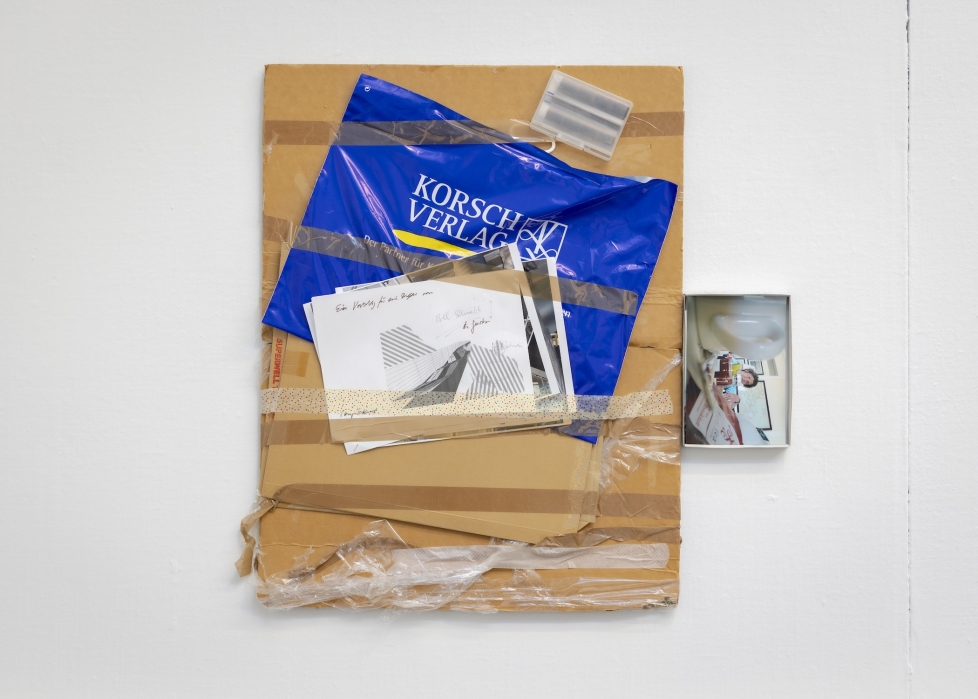
Across from them hang four assemblage-paintings in which cardboard, foil, slide transparencies, photo printouts, packing plastic, disco-ball material, clothing, and miscellaneous debris are forced together with tape. In one, a photograph of the artist is embedded in a jutting box. The image is shot from a cramped, almost claustrophobic angle: Genzken appears far back in the frame while the foreground is jammed with things – teacups, papers, jars – as if she’s caught in a way of seeing where things are always in the way of any overarching comprehension. Like a magpie, she is both attracted to and distracted by whatever glitters.
Across many of the works, a naively wide-eyed gaze emerges, locating beauty in all the trash in the world – plastic bags, souvenir postcards, feathers, dollar-store nonsense. Simultaneously, the tackiness of the everyday collides with a more archaic beauty made strange by the present: an ‘antique’ plaster statue resting on a tarpaulin and connected through a tangle of headphones to an iPod Shuffle (Untitled, 2018); Sandro Botticelli’s Portrait of a Young Woman in postcard form (Untitled, 2015); or a kitschy Madonna sculpture – also smeared with paint – installed inside one of Genzken’s MDF skyscrapers (4 Towers, 3 Stelae, 2015).
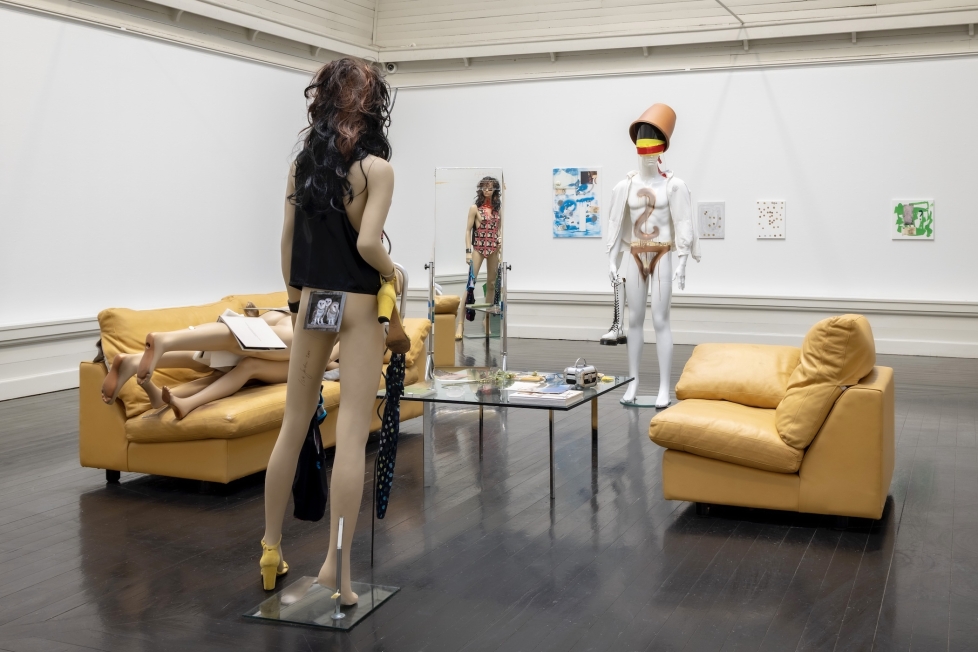
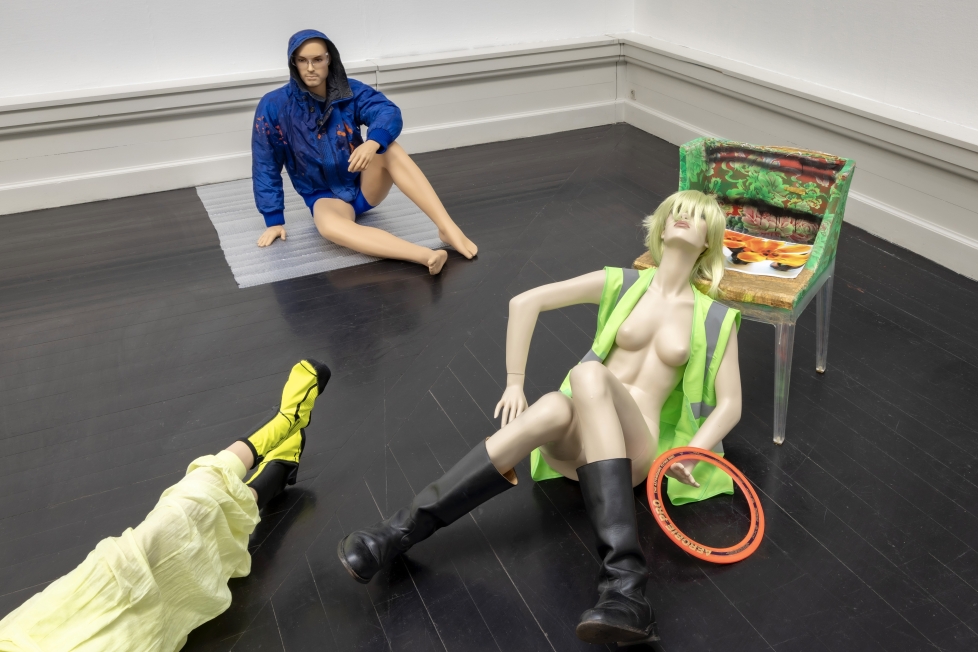
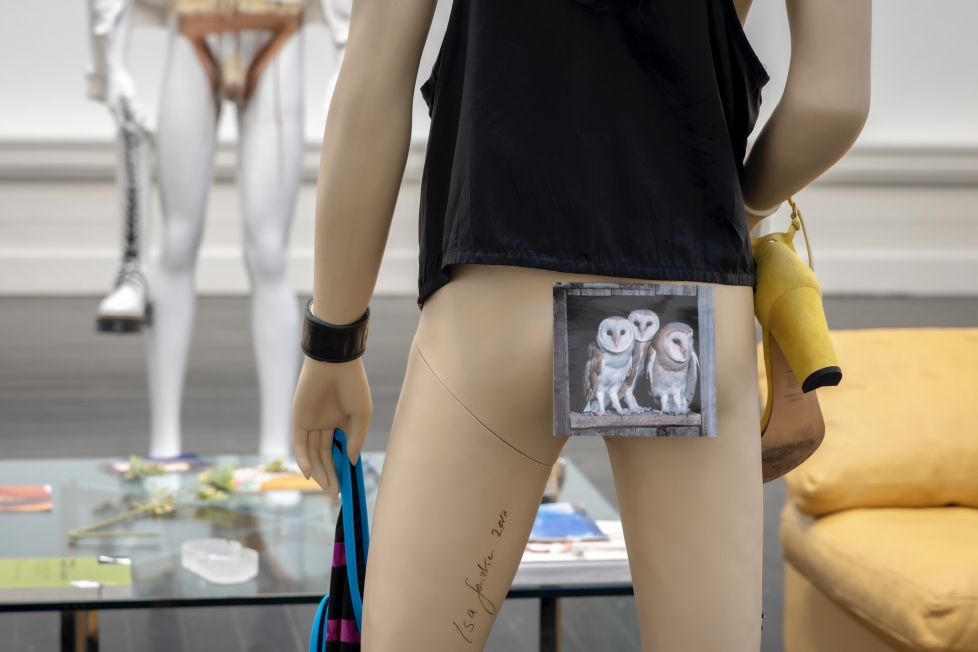
The exhibition exists in a state of flux, as if in transit. References to travel – boarding passes, sleep masks, headphones, packed bags, cigarette packets, pilot hats, cash – generate a persistent sense of being en route without an anchor. In the central room, about ten or so mannequins stand in various clusters. The atmosphere is uncannily like the late Berlin Tegel Airport on a Monday morning: absent-minded children and adults overloaded with experiences and necessities in a kind of warped jet-set aesthetic under the mantra “barely done, barely there.” And yet we are already at the club or out on town. In one corner, airport workers in fluorescent vests have sunk into a narcotic haze – collapsed on the floor tits out, or swaying through a blurry dance. Opposite a small boy, his tape recorder wired to a string of lights worn like headphones, stands a naked hunk in a harness and a wig. It’s like time has flatlined into a single three-dimensional plane.
The collapse of time and place plays out structurally, too. A line of newspaper clippings implies sequence yet delivers no chronology. Instead, the war images cut from Der Spiegel read as a manic attempt to impose order on an over-saturated image society. The absence of wall labels makes it impossible to read the exhibition as an oeuvre in progression. Instead, the rooms follow an associative current where experiences slide into one another. Events fold in on themselves; memory and possible futures are mixed in a blender.
Here lies the curatorial challenge: each work infects the next, producing new relational readings as visitors puzzle their way through heaps of bric-a-brac. How to honour the mess that the practice embraces while retaining Genzken’s extraordinary precision, her unerring sense for the clash and click of materials and forms? Does the presentation risk becoming too controlled?
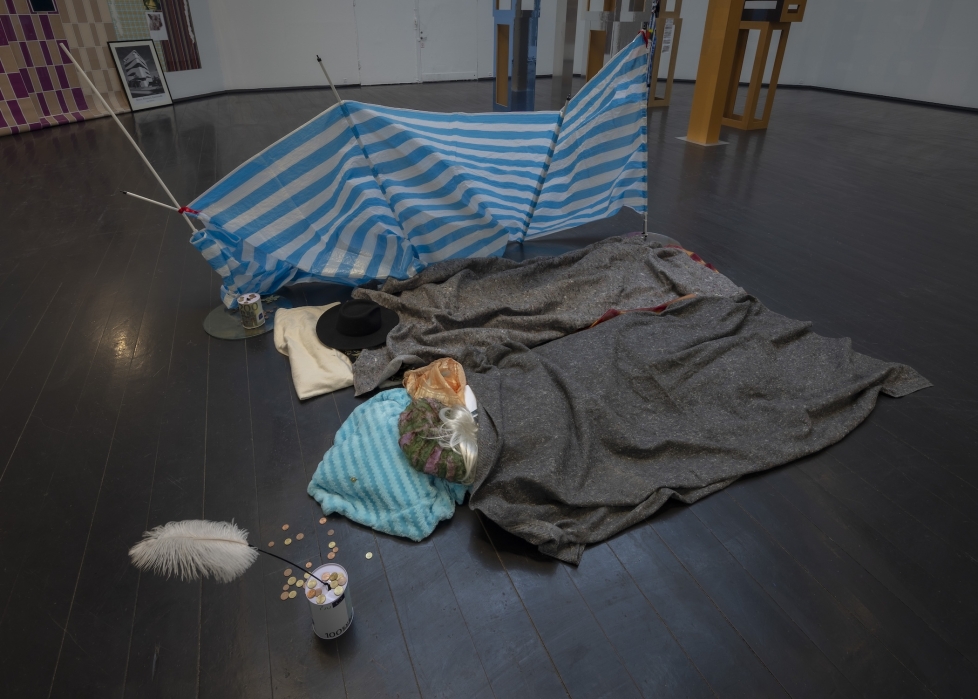
For the most part, the exhibition succeeds. But at moments, the staging veers toward the literal, as in the skyscraper room, where faux-tile wallpaper feels like a subway backdrop for a bunch of homeless people hidden under blankets, behind wonky windbreaks. Den Frie is not a white cube in which these assemblages can float freely in a void. It’s an early twentieth-century wooden pavilion with black floors, panelling, and rounded circus-tent-like rooms that are themselves absorbed into the mise-en-scène. It’s not exactly a problem, but Genzken’s mischievous bricolage – so compositionally exact, for all its scruff – would benefit from a little more distance to reality than this setting allows.
Money, money, money is everywhere in the exhibition, but rather than reading as an elevated symbol of value, capitalism, or anything else from on high, bills and coins feel like a material condition and a source of anxiety: to have it or to lack it. Desperation materialises when euro banknotes get literally glued onto canvas in the final room, as if trying to pin down something that might otherwise slip away. It’s one example of how the exhibition makes ample space for personal neuroses: the homeless are not only a capitalist archetype or a way of processing metropolitan impressions, but also a possible future running parallel to the equally unstable fantasy of a derailed jet-set life.
Walking through World Receiver, I’m struck again by how Genzken’s work seems to touch the present. Not because the works are new (everything here predates 2018), but because great art is prophetic. Among all these coerced fragments of the now latched together with tape, wire, and glue my mind turns to Maya B. Kronic, Daniel Felstead, and Jenn Leung’s neologism “jankspace,” which over the past year was introduced across podcasts and a video essay titled “Welcome to Jankspace” on dis.art.
Jankspace names the unregulated zone where technical and economic systems don’t quite align and therefore require human bodies, brains, and improvisation to run smoothly. It might look like an Uber driver’s duct-taped bike-and-phone rig: multiple devices, chargers, and apps held in simultaneous operation, gloves affixed to the handlebars, the body acting as living glue between interface, restaurant, and the fantasy of a frictionless meal delivered in a few clicks. The term describes how people fill the gaps between systems, produce their content, and acts as a kind of fleshly adhesive – janky bodies. Against this, glossy rational infrastructures maintain a dream of pure smoothness, a world in which bodily drag is engineered away. In practice, the body is what both bugs and lubricates the connections between code and infrastructure, being unwanted and needed at the same time.
In Genzken, jankspace is concrete aesthetics: taped surfaces, stacked objects, bodies in impossible positions, sculptures that seem perpetually on the verge of coming apart. Her mannequins embody this nervous condition perfectly. In Untitled (2018), for instance, where layers of clothing, tourist images, and an antenna have been strapped onto a body with cable ties. The artist’s relationship to image feeds is also central. War photographs, postcards, art-historical reproductions, and everyday snapshots coexist without resolving into narrative. And yet everywhere we sense the desperate compulsion to arrange, to sort, to make things make sense: a frantic attempt at legibility amid the surplus of images that our moment supplies.
I once read Genzken’s practice as powered by passion, an affective ambivalence toward consumer culture, equal parts desire and refusal. Today, it feels more unmoored, less cocky. The feeling is less that of swagger than that of perpetually being in the wrong place at the wrong time: arriving late to the party, or failing to find your way home. This melancholy is concentrated in the exhibition’s central room, in an installation made in collaboration with Wolfgang Tillmans. Straight ahead, a wall is covered by a photograph taken in Tillmans’s studio after an afterparty. As a visitor, I am trapped between two tall mirrored walls, groping in a kind of infinity at the end of the night.
Moving through Den Frie becomes a series of attempts to surface, to orient myself, made difficult by the density of things. And yet those things also soothe: comfort blankets, anchors, points of fixation in a room where direction has been lost. I no longer read the objects in Genzken’s assemblages as ironically polysemic fetishes, but as sincerely beautiful icons – where beauty itself becomes necessary as something to hold on to when the whole refuses to cohere. Even if all this jankiness implies fragmentation and exhaustion, it also contains a stubborn freedom and creativity because it takes place in the interstices of techno-capitalism.
As in the provisional tech setups where people patch life together between apps, platforms, and interfaces, Genzken’s assemblages are driven by associative invention. To revisit her now is to be reminded of art’s ability to speak of a time that has not yet happened – to be, in the most literal sense, a world receiver.