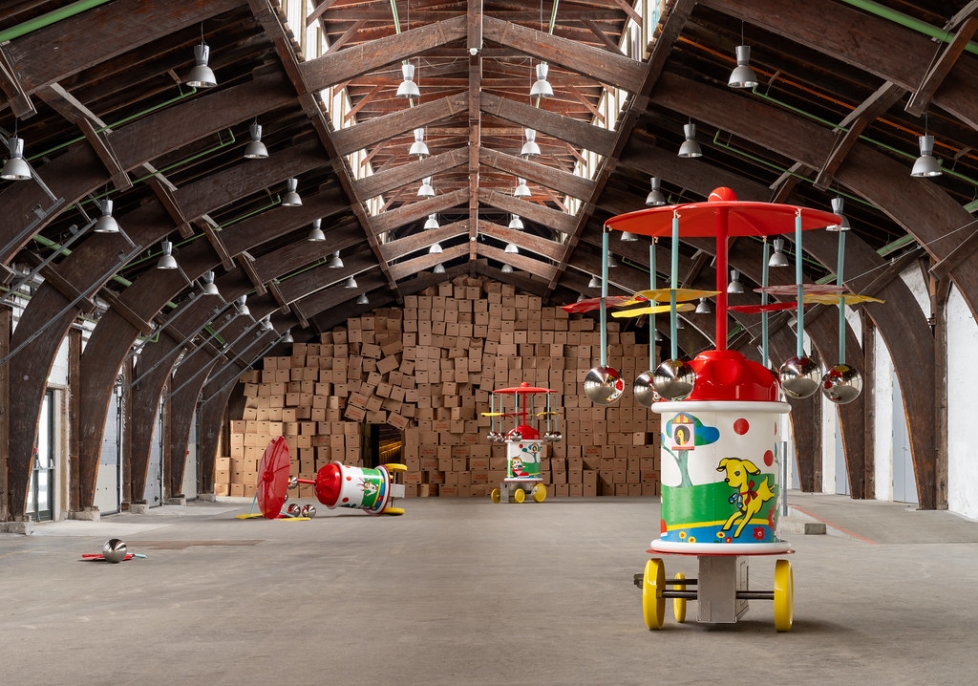
With its nearly one thousand square metres of exhibition space, Rå Hal (literally Raw Hall) at Godsbanen in Aarhus is no small space to fill. And when you’ve decided, as curator Rebekka Laugesen and the professional jury behind the exhibition programme have, to showcase very young visual artists, pulling it off is an achievement in itself.
Kåre Frang is a strong choice: a relatively recent graduate who nonetheless works on a scale that can hold its own in such cavernous surroundings. At the Heartland festival in 2024, he showed the monumental installation Portraits of Overwhelm, a full-scale replica of a section of a flooded Copenhagen street. Add to that the fact that Frang works across almost every medium – from video at the Royal Danish Academy of Fine Art’s degree show in 2020, through painting and larger sculptural works, often with accident and misfortune as a thematic pivot – and he begins to look like an ideal fit for an exhibition of this magnitude.
Perhaps that’s why I initially feel a flicker of disappointment when I step into Rå Hal and see that Frang has approached the task much like Benedikte Bjerre and Eliyah Mesayer before him: by repeating a single sculptural element down the length of the hall. Not that there’s anything wrong with that approach. But in this case, multiplying the sculptures does not necessarily bring home the point of the individual work.
The space is a former goods station, and this history becomes the point of departure for three sculptures, each of which is a greatly enlarged version of a toy train. Two stand upright; the third lies on its side as if derailed, or as if a giant foot had accidentally kicked it over. The model is supposedly a Japanese wind-up locomotive from the 1960s, with bells hanging from the roof and delicate hand-drawn motifs along the sides.
That hand-drawn retro imagery, with its naïve nursery-school aesthetic, connects neatly to Frang’s earlier work with neo-pop-leaning landscape paintings based on jigsaw-puzzle scenes. There’s something playful and genuinely lovely about taking this children’s universe seriously as a painterly genre with historical weight. The three locomotives strike me in much the same way: catchy as a pop song, yet also faintly unsettling, the way children’s things almost always feel when they turn up in an adult setting.
The show’s second element is a short film screened in a black box built from moving boxes, with the exhibition title, Your Cards Are Bleeding, printed on the sides. You can sit on several of them and wrap yourself in removal blankets. The latter is an absolute necessity if you want to hold an audience for a good half hour in an unheated space in the harshest winter Denmark has seen in years.
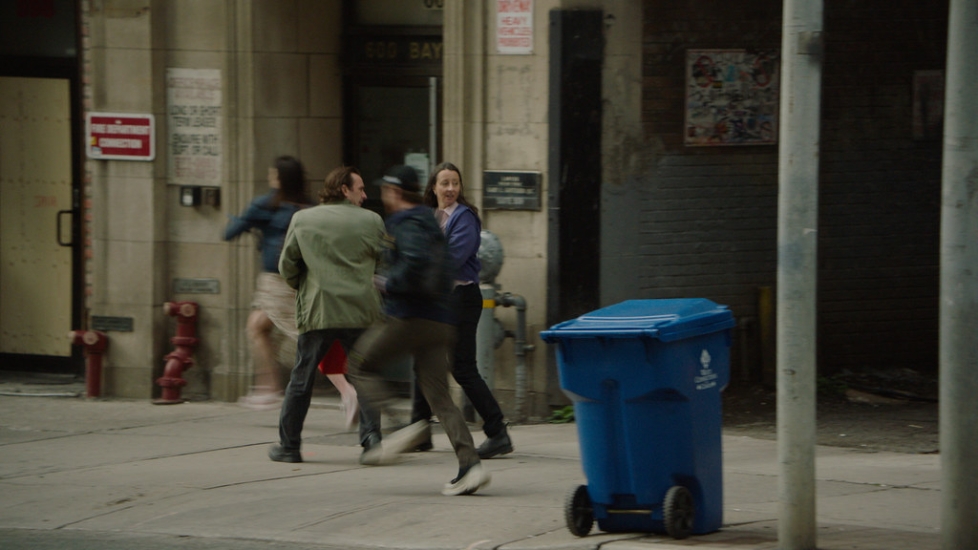
In the film, we follow a young couple with a baby as they navigate a deeply frustrating situation. Their unbelievably irritating friend Stanley has, for reasons unknown, failed to show up for his own move, and the couple suddenly find themselves saddled with the task. From there, the day spirals into an extended nightmare of mishaps and interruptions almost without pause: from the everyday irritation of trying to have a serious phone call while someone’s being incredibly noisy in the background, via domestic accidents like dropping a laptop into the washing-up bowl in a split second of distraction, to a full-on sense of catastrophe, as when everyone else on a crowded street suddenly starts running and they have no idea why.
The work is poised somewhere between disaster movie and comedy, and the film’s funny scenes and its unsettling undertow both run on recognition. It’s very easy to identify with the gradual breakdown of the couple’s nervous systems, a direct result of constant disruption and a fundamental sense that disaster looms just out of sight. You completely understand why, in the film’s final scene, the male protagonist finally snaps and hurls Stanley’s moving boxes off the roof of the building he is moving into. At first glance it feels like a release. But is it, really?
Frang’s film raises a string of fundamental moral questions about who takes responsibility in a contemporary world that pushes all of us right to the brink. Who is equal to the task, and what strategies do we have to shield ourselves from all that threatens and derails us? Is there an adult in the room?
The film is well made and entertaining. Yet for all that it leaves me slightly despondent. Because even though the couple display an almost unimaginable patience with their eminently punchable friend, the outcome seems to be that their general capacity for empathy is dulled. In one scene they pass a sobbing teenage girl in the street, barely registering her as anything more than yet another warning sign. We overhear the female protagonist on the phone with an acquaintance who has just lost someone close, a conversation made up of no doubt well-meant but fairly superficial clichés delivered while she multitasks at home. And their child – who they carry in a baby sling throughout – seems, above all, to be in the way, an awkward object passed back and forth between the parents.
The film is an incisive portrait of the human condition today, and it feels unnervingly current at a time when irresponsible politicians who send ICE agents after their own citizens form unholy alliances with the tech bros whose social media platforms tear at our attention. Frang’s film diagnoses the present moment in a way where no real catharsis takes place. Because it is not, in any real sense, a viable solution to simply follow your immediate emotional impulses and hurl the moving boxes off the roof – even though Stanley really, truly deserves it. Instead, Frang seems to suggest that the mature response to a world in free fall might be to protect one’s nervous system, gently, from all the noise. And we could probably all use that right now. Except Stanley. He just needs to get his shit together.
– Translated from Danish