Klara Lidén moonwalks her way through the dark nighttime streets of Manhattan. She glides across the pavement or along a busy road while bright headlights whoosh past. She moves backwards while walking forwards. That’s the whole point of this mesmerising technique – also known as the backslide – which is forever tied to Michael Jackson, even though he didn’t invent it. It’s tied to Lidén too, thanks to the video work The Myth of Progress (Moonwalk) (2008). The artist performs the movement so slowly you almost manage to nick the trick – and yet you don’t; it slips from sight just before the raised arm or lifted heel is swallowed by the darkness. The video only lasts a few minutes, and it hits me every time. All I want is to watch Lidén slide backwards through the city night, again and again.
“Was the moonwalk video in it?!” a curious Swedish artist asks at an opening in Copenhagen after learning I’d visited Lidén’s exhibition in Berlin earlier that day. “And the one where she dances on the Stockholm underground?” Yes, they’re both there in a show that spreads across three floors at KW Institute for Contemporary Art. It’s not only Lidén’s first retrospective. Surprisingly, it’s also her first solo institutional show in the city where she has lived for the past twenty years. And while she hasn’t been all over the institutions, she’s certainly been prominent on Berlin’s art scene.
The exhibition title, Kunstwerke, is, of course, an obvious choice for a retrospective, perhaps especially so if German isn’t your first language. I really can’t imagine a German artist from the same generation (Lidén was born in Stockholm in 1979) calling their retrospective that; there’s too much Kölsch and Bratkartoffeln about it. “Kunst-Werke” is also, of course, the kunsthalle’s original name before it was hit by the worldwide acronym virus born out of a nearly hundred-year-old fascination with the MoMA effect, an approach which today sounds more like standardised branding.
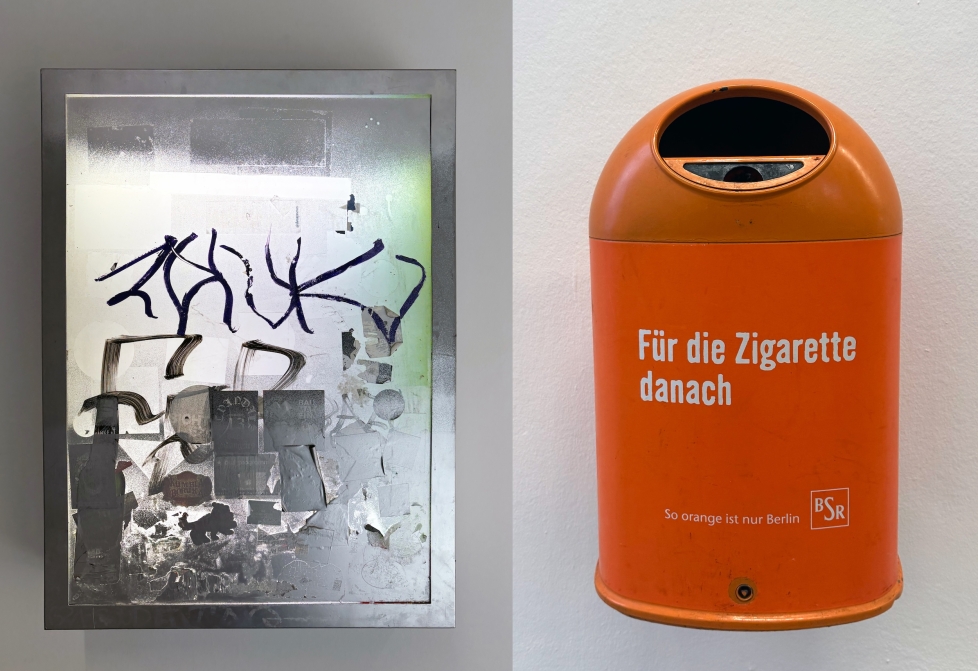
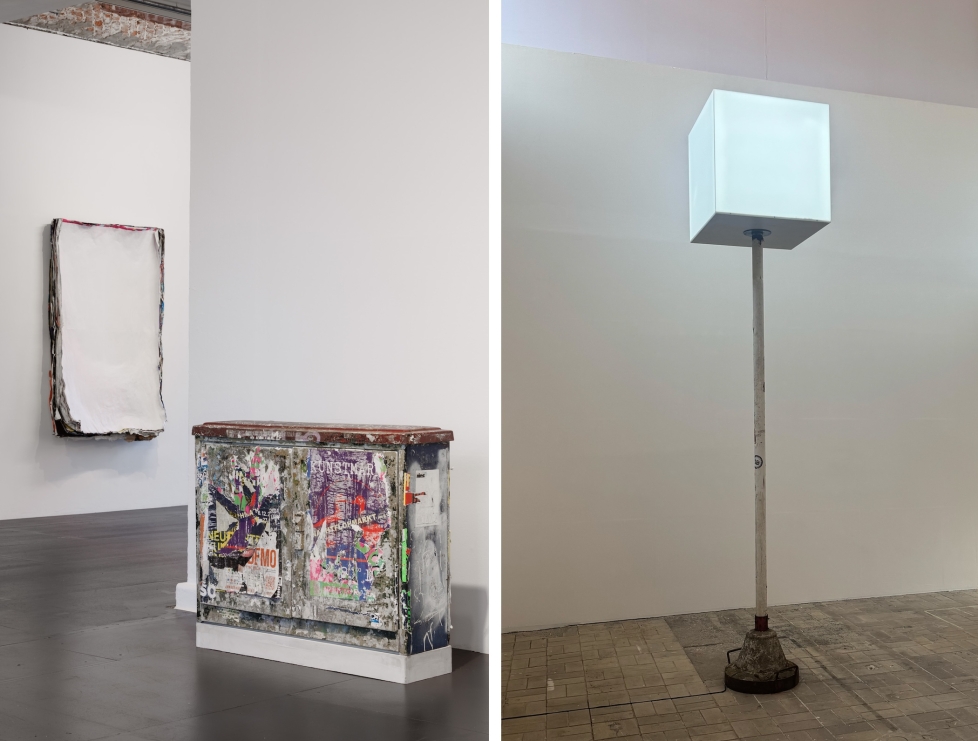
Still, KW remains a slightly battered kunsthalle, one that lets loose plaster drift down from raw brick walls onto the floor in a way that would be unthinkable in a neatly polished Scandinavian counterpart. That aspect feels important for this particular show. The city seeps in through those cracks. In KW’s surroundings, the urban space, which is Lidén’s material, is effectively set while framing the urban furnishings the artist has hauled into the institution: a dented bin from Hamburg with cheeky municipal sticker-poetry urging passers-by to let go of their troubles: “Hier Deine Sorgen einwerfen” (Untitled (Trashcan), 2024); the empty bus-stop sign stripped of all information about routes and directions (Untitled (Haltestelle), 2024); or the five utility cabinets lined up in a row, which, despite the array of tags and stickers (and individual work titles), still speak of the authorities’ shared commitment to shades of pale grey when it comes to the colour of infrastructure.
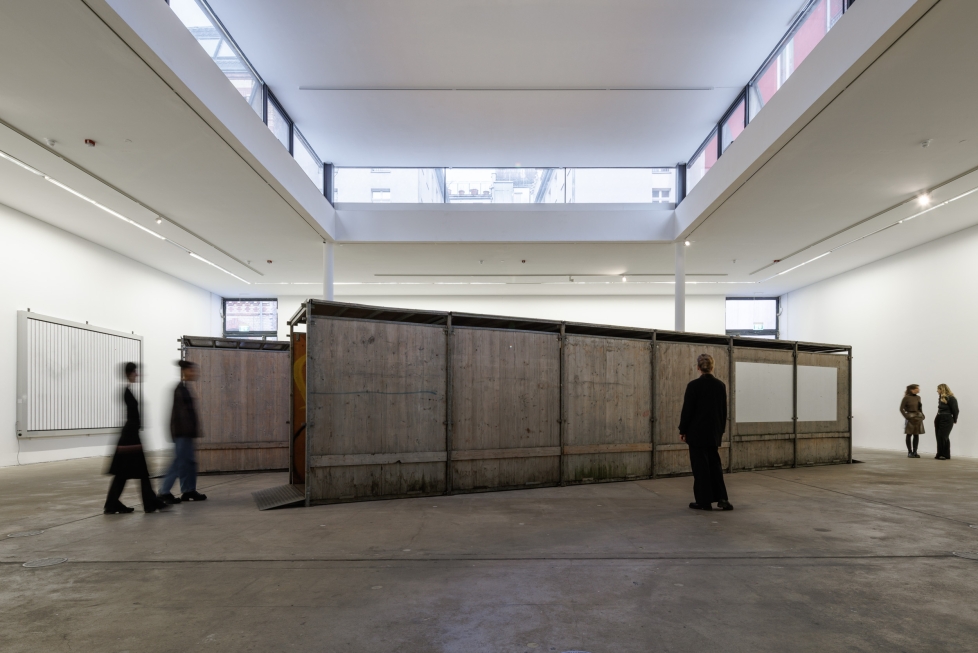
Down in the kunsthalle’s large basement hall stands the sculpture Rosie Rosie (2026) – essentially two corridors of wood and steel of the kind that protect pedestrians during building renovations. Seen from the staircase looking down into the space, the first impression is one of Minimalist sculpture with perfect proportions. These modular corridors are made for human bodies, so that part of the sculptural logic is in place. Up close, you see they’ve been used many times: the panels are tagged and scuffed.
If Walter Benjamin taught us that the nineteenth-century Paris arcades symbolised capitalism, commodity fetishism, and the modern metropolis, then Lidén’s passage work is an image of today’s shoddy structures pointing toward the decline of old-world capitals condemned to perpetual restoration. That’s certainly been Berlin’s story for the past thirty years. And unlike the inviting glass-and-steel shopping arcades of the past, the bruised, recycled corridors are reduced to pure function – even if the sense of protection that they offer is often rather less convincing. Aren’t we always a little relieved when we exit such passages? It’s precisely this sense of exposure that injects a sense of vulnerability into Lidén’s works.
On the one hand, that is. On the other, Rosie Rosie obviously looks unbelievably cool in the kunsthalle’s big space with its paint-spattered concrete floor and views of graffiti in the sealed-off back courtyard. And that’s also where the exhibition’s biggest challenge lies. Does Lidén fall off the knife-edge she’s dancing on?
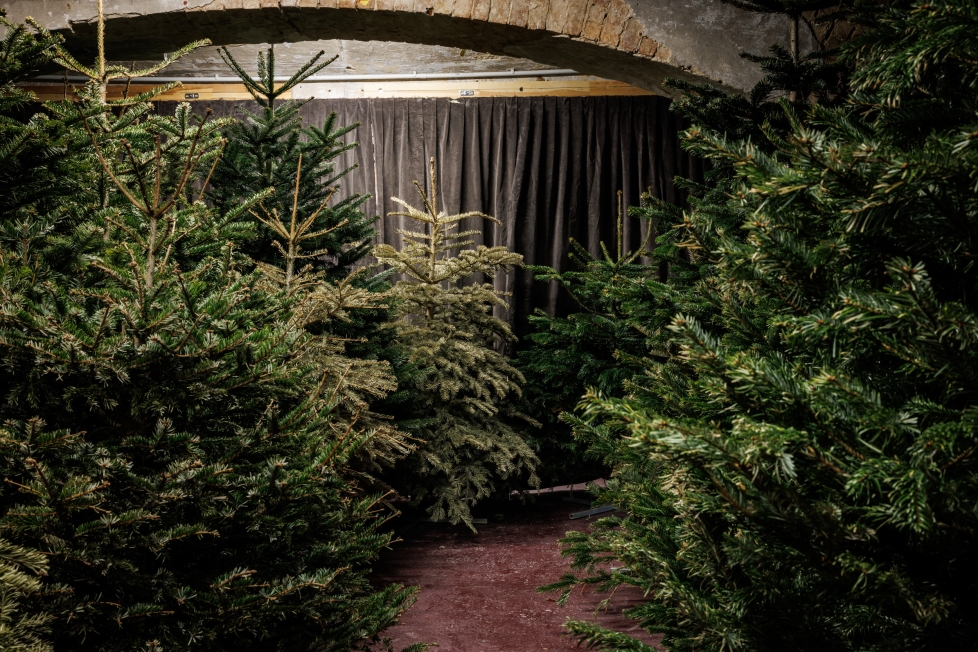
From the basement space you can enter two immersive installations that take the edge off that nervousness. S.A.D. (2012/2026) is a room stuffed with discarded Christmas trees – it feels as if you’d arrived at the spot in the city where the authorities collect them by appointment. There’s hardly a sadder version of nature than lopped-off trees propped upright again like that, but S.A.D. is also like a pop song with a melancholy undertone. Hidden behind the trees is a small black leather sofa, almost as if someone snuck something into the bulky waste container to make a little refuge, a place where a homeless person might grab some sleep, or teenagers might hang out and smoke. These two groups have one thing in common: they’re constantly seeking out the city’s unregulated cracks and fissures.
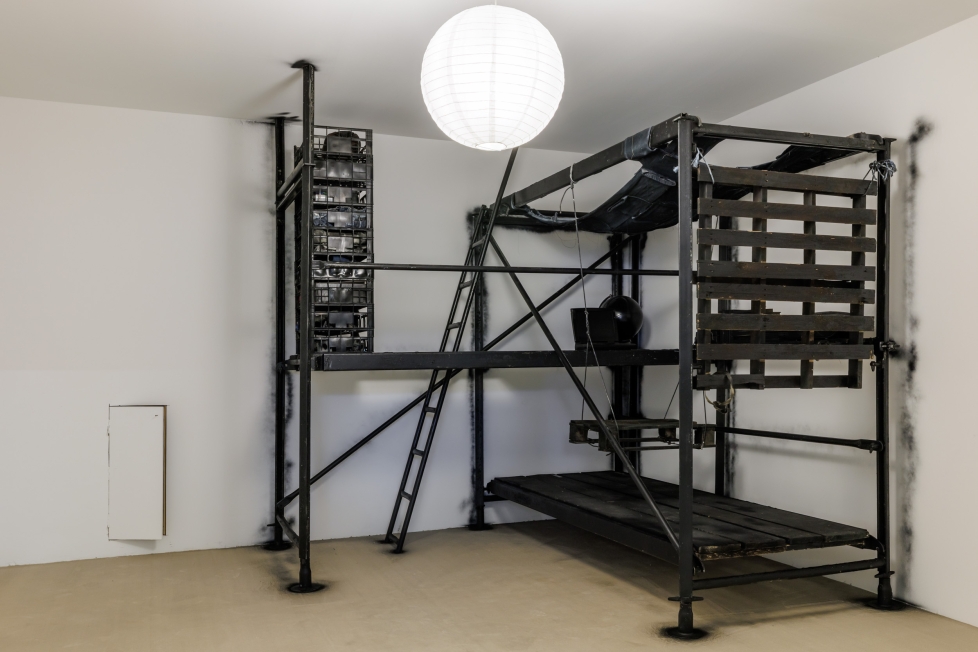
Surely, the dream of having your own territory is nowhere expressed more clearly, more nakedly, and with more fundamental humanity than in a teenager’s room. In Lidén’s installation Teenage Room (2009), every last thing is painted black – from the bunk bed to the stacked vegetable crates where all the clothes are kept – set in sharp contrast against a chalk-white fitted carpet, a reminder that there are always limits to free self-expression, whether they’re imposed by parents, by capital, or by the state.
The older you get, the harder you have to fight to hold on to the teenager’s natural X-ray vision: the ability to see through myths of growth and progress, including all sorts of infrastructure that regulates our physical, psychological, and social behaviour. No future, the teenager concludes, and makes a hammock out of black jeans or a chair out of a black-painted Euro pallet – as the artist does here. While the parents may think it’s cute and funny, for the teenager it’s deadly serious: it is a struggle for freedom. The parallel to society’s relationship with the artist is obvious – if, that is, you subscribe to notions of the romantic figure of the artist, which I actually suspect Lidén does, deep down under that secular, Constructivist attitude. The seriousness surrounding the teenager’s “room of one’s own” gives it away, even if it also makes the piece feel a bit corny. But it’s corny in a brave way, and its inclusion in this exhibition feels important.
Something about Lidén’s sensibility reminds me that New York often seems closer to Stockholm than it does to Copenhagen. The story of successful Swedish productions of American pop music is one thing. According to a young Swedish art critic I met recently, it’s still the case that whenever poetry starts trending in New York, it’s hip in Stockholm the week after. When it comes to visual art, I’ve often wondered about the impact of having an artist like Öyvind Fahlström find success in New York in the 1960s. Or that the founder of Moderna Museet, Pontus Hultén, mounted a vast Pop-Art exhibition featuring Jasper Johns, James Rosenquist, and Andy Warhol back in 1964 – to say nothing of Warhol’s first solo show in Europe. Does all this somehow explain that even today, Swedish artists have easier access to that legacy?
Whatever you make of such speculative analyses, it’s clear that Lidén rather effortlessly picks up the thread from a golden era in the city tied to names like Vito Acconci and Yvonne Rainer. Interestingly, it’s roughly the same moment and scene that Karl Holmqvist – another Swedish expat in Berlin and an equally central figure on the scene – also hooks into in his text-based works.
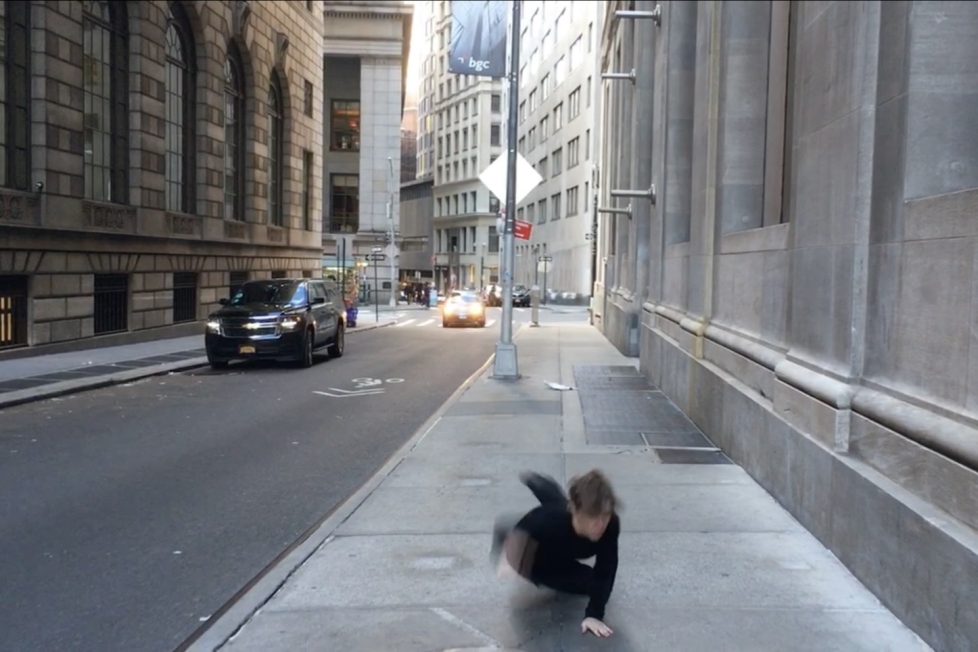
The link to 1960s performance and dance is most obviously visible in Lidén’s video works. They rarely run longer than a pop song, and each one hinges on a single simple concept carried out by Lidén herself. In Grounding (2018) she walks through the streets of Manhattan’s Financial District. At regular intervals she trips and falls, gets up again and keeps walking, only to fall again shortly afterwards. It feels completely real, as if she hurts herself every time. And yet, the execution is light and agile; Lidén is physically strong and technically skilled. Even if the works aren’t about that, it still makes sense to compare her older and newer videos in terms of that trained body.
In Paralyzed (2003) – filmed on the Stockholm underground, three years before Lidén left the city for good – she dances around a carriage with wild abandon. She flings off her jacket and trousers, throws her shoes through the carriage, swings from the grab rails, does somersaults and climbs up into the luggage rack. A folk-punk soundtrack, all noisy instruments and whooping shouts, drives the attitude home. In the final sequence, where we only see the carriage from the outside as Lidén jumps around inside it, the music is replaced by a live recording from a gig and a voice that yells, in Swedish: “Shall we keep fighting?!!” “Yeeees!!!” the audience answers in unison.
There is a palpable difference between the punked-up energy of Paralyzed and the technically demanding falls done fifteen years later in Grounding. It’s the kind of development you might observe in plenty of artists who have managed to carve out a longer life in the ring. You have to hone yourself and toughen up. That is especially true of an artist who has put her own body on the line in concrete encounters with pavements, bins, bus stops, fences, and buildings. In that sense, KW’s retrospective shows that Lidén has gone professional: she keeps her body strong and her gaze fierce. But I don’t think the vulnerability has been lost. If Lidén slipped off the knife-edge she’s dancing on, I’m sure she’d still get hurt.
– Translated from Danish.