Most people are familiar with Herman Melville’s Bartleby, the Scrivener (1853), whose polite “I would prefer not to” has come to epitomise a peculiar form of resistance. Once read as an allegory of modern alienation, Bartleby is now often seen as a model of contemporary refusal. Philosophers such as Gilles Deleuze and Giorgio Agamben emphasise how he suspends the choice between obedience and defiance, undermining the system’s binary logic rather than confronting power with a simple “no.”
Today, that gesture has migrated from politics to aesthetics, as resistance takes other forms than revolt; instead of breaking with genres, artists drift between them. In contrast to the avant-garde strategy par excellence – Bertolt Brecht’s Verfremdungseffekt, where the passive is negated to produce the active – we might speak of a Bartleby effect: a suspension between abstraction and figuration, contemplation and action, and so forth.
For the last fifteen years, the Swedish artist John Skoog has produced a number of short and feature films that defy easy categorisation. Drawn to Bartleby-like outsiders, he has made both a film and an exhibition about the somewhat obscure Swedish artist Richard Vogel (1953–2015). Now, he has also completed a long-standing project about Karl-Göran Persson (1894–1975), a farm hand who rebuilt his home into a bomb shelter from the 1930s onward. The concrete structure still stands in the Scanian countryside, and is said to have inspired the artist Lars Vilks (1946–2021) to construct his site-specific sculpture Nimis (1980–2021) out of driftwood and found debris. Yet, where Vilks embraced the avant-garde’s negative logic of provocation and revolt, Skoog operates, not by overturning the system, but by loosening its hold, declining to fully inhabit its oppositions.
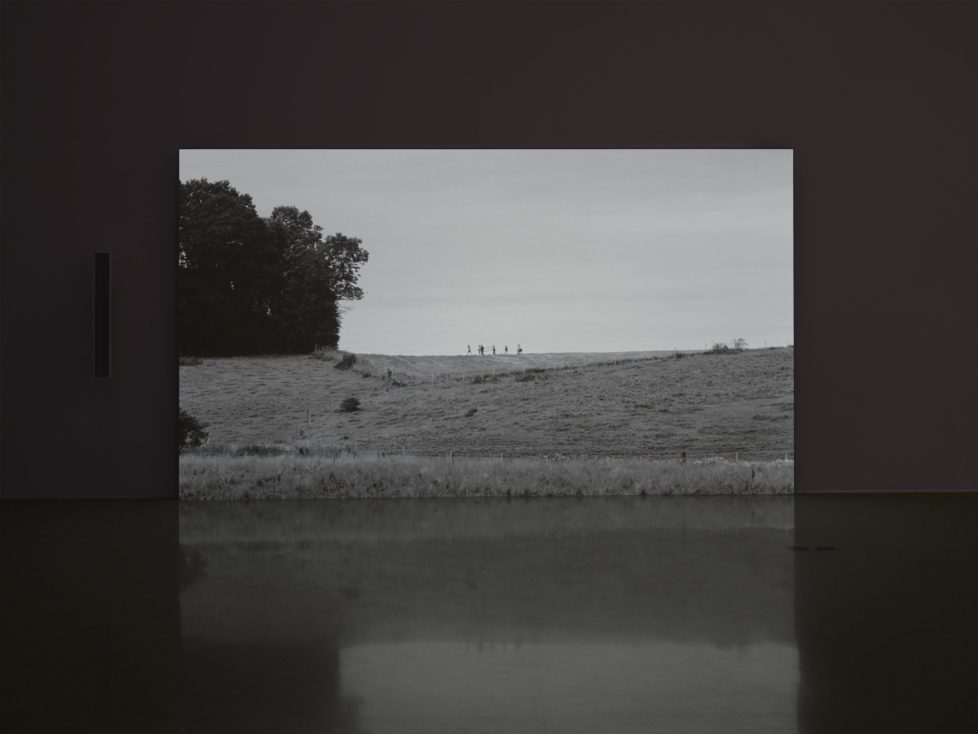
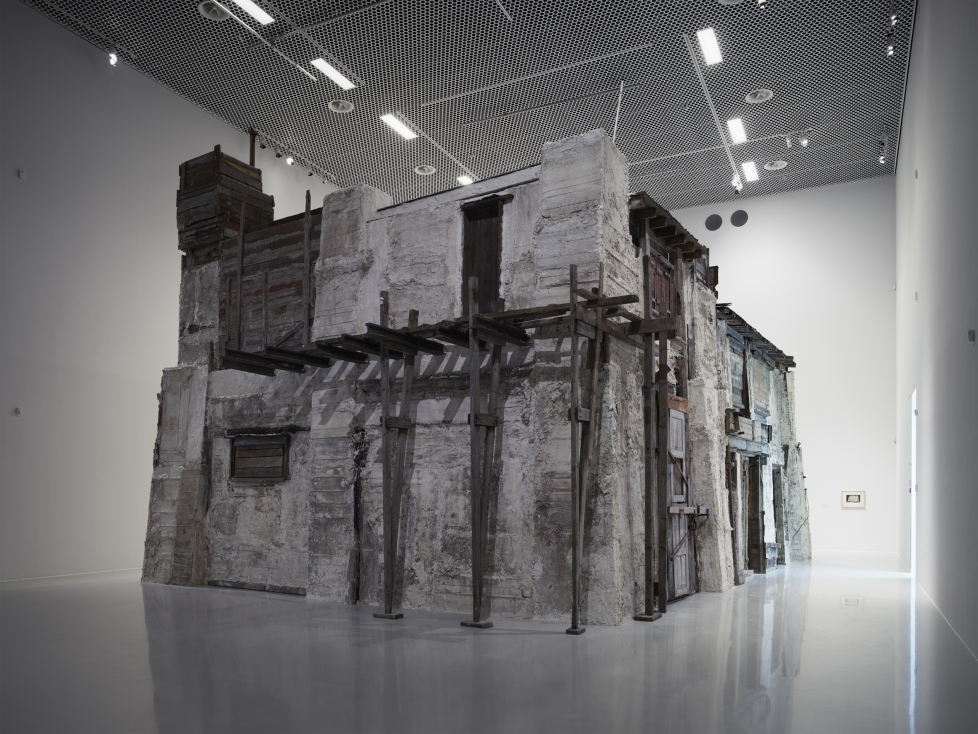
Skoog’s project on Persson comprises the feature film Redoubt (2026) and an exhibition of the same name at Moderna Museet Malmö. In keeping with its Scanian roots, the exhibition centres on the massive fortress itself, reconstructed for the film and now squeezed into the museum’s Turbine Hall, where it looms over visitors with its rough walls and stale, damp odor.
The film, starring Denis Lavant as “Karl,” has received glowing reviews, many praising the French actor’s extraordinary performance – and rightly so. With restless intensity, he portrays the protagonist as an eternal child, endlessly toiling away on the margins of the surrounding community. On the rare occasions when he does interact with others, the encounter acquires a peculiar aura, as if time itself had momentarily thickened.
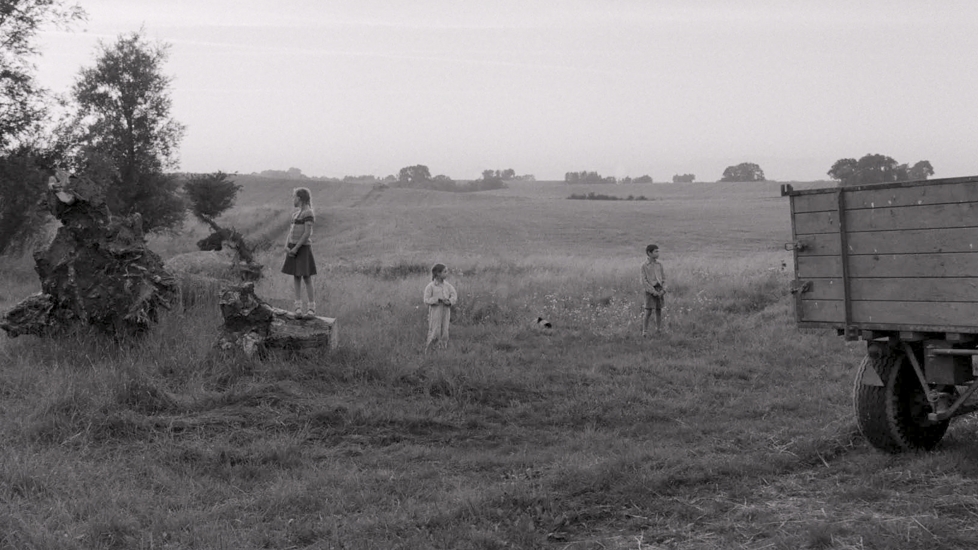
Yet in the exhibition, Lavant’s animated presence is excised. What remains is the fortress alone, monumental and mute. The removal of the actor transforms the project: what in the film feels unstable and human becomes, in the museum space, an object of mass and permanence. In a shortened version of the film called Eklipsis (2026), also on display, Lavant’s scenes have been omitted in order to focus on the children who move around the fortress. They observe Karl, comment on his activities, play hide-and-seek, and build a hut of their own. Eventually winter arrives. The children organize a Saint Lucy’s Day procession and wander across the snowy fields dressed in white robes. Where Karl is a specific event – a fold in time – the children appear as eternal observers without attributes of their own.
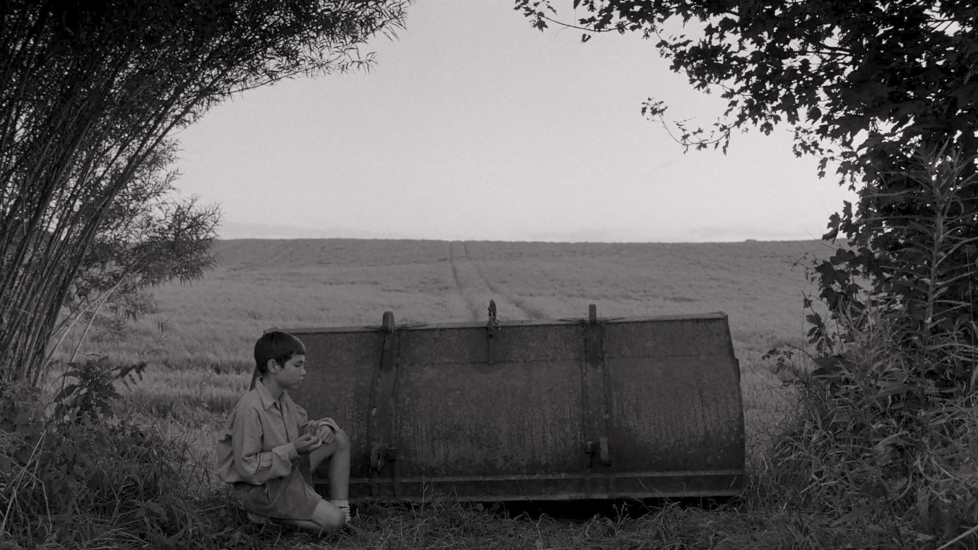
Skoog’s films are marked by extended takes, lingering cinematography, and a striking lack of conventional action. In the spirit of film theorist Tom Gunning’s concept of “cinema of attractions,” which describes early silent film’s preoccupation with “the visual thrill,” Skoog’s approach might be called a cinema of suspension. Indeed, Redoubt’s visual moments unfold slowly and without tension, immersing the viewer in dim twilight atmospheres and subdued imagery. Still, the film appears less radical than Skoog’s non-hierarchical feature debut Ridge (2019), which sought to put settings, characters, narrative, lighting, and camerawork on equal footing. Redoubt’s structure is more traditional, with its messianic protagonist meant to redeem the community’s fear of an impending catastrophe.
Even so, Redoubt resists the conventional structure of the biopic through its horizontal form, in which little happens beyond Karl continuing to build his fort. When events do occur, they unfold with a studied lack of drama and without psychological development. Indeed, it might be Skoog’s most Bartlebian work to date, simultaneously participating in and suspending the conventions of the genre without actually revolting against them.
In Eklipsis, the children’s procession culminates in an anti-war hymn, anchoring the exhibition firmly in contemporary discourse. Their delicate voices echoing through the Turbine Hall, however, verge on validating Karl’s paranoid worldview, eerily mirroring today’s escalating military rearmament. Here, framing the present as the echo chamber of history risks drifting toward propagandistic territory, where beauty and fear converge to make the political logic of arms buildup feel inevitable, though it clearly is not.
Ultimately, Skoog’s artistic choices reflect how contemporary art turns politics into images, which tends to give urgent issues an idealistic and activist bias. The film with Lavant, by contrast, feels more nuanced, ending with his character trapped inside his fortress. Time roars, as he pleads for everything simply to end. The shelter is no longer protection against an external enemy, but a prison of his own making. Karl is like a late-capitalist Samuel Beckett character who, instead of idling, has internalised the demand for productivity and kept labouring into life’s final phase. In the end, all that remains is the cell he built for himself for no good reason at all.
Meanwhile, the fort looms as a testament to the labor and energy poured into its construction. Yet, it is also mutable. Doors appear here, windows there; nothing follows a clear logic. Moving around it, I feel off balance, as if the structure itself resists comprehension. It stands as both a monument to human labor and a living presence, unstable and uncanny, mirroring Karl’s spectral quality. It is frozen, yet suspends life and death, past and present; one cannot fix its meaning, only inhabit its eerie, ambiguous space.
As contemporary art has become increasingly entangled with commercial interests and institutional spectacle, it seems inevitable that resistance itself would harden into an autonomous aesthetic form. This, perhaps, is the paradox that Skoog seeks to inhabit. Rather than staging overt opposition, he produces works suffused with dreamlike, ambivalent atmospheres that he describes, in an interview with the Swedish film journal FLM, as a “radicalised romanticism.” Indeed, Redoubt possesses a quiet dignity, even a gentle beauty, which can certainly feel like resistance in a world dominated by the crude imperatives and vulgar affects of power.