After experiencing Zambian-Norwegian artist Anawana Haloba’s exhibition Jeg vil si deg noe (I want to tell you something) in the National Museum of Norway’s Light Hall, I was abuzz; her humming stayed with me long into the day. Throughout the exhibition, the artist’s soft voice can be heard echoing the American folk singer Woody Guthrie’s ‘This Land Is Your Land’, and the melody stays in my mind.
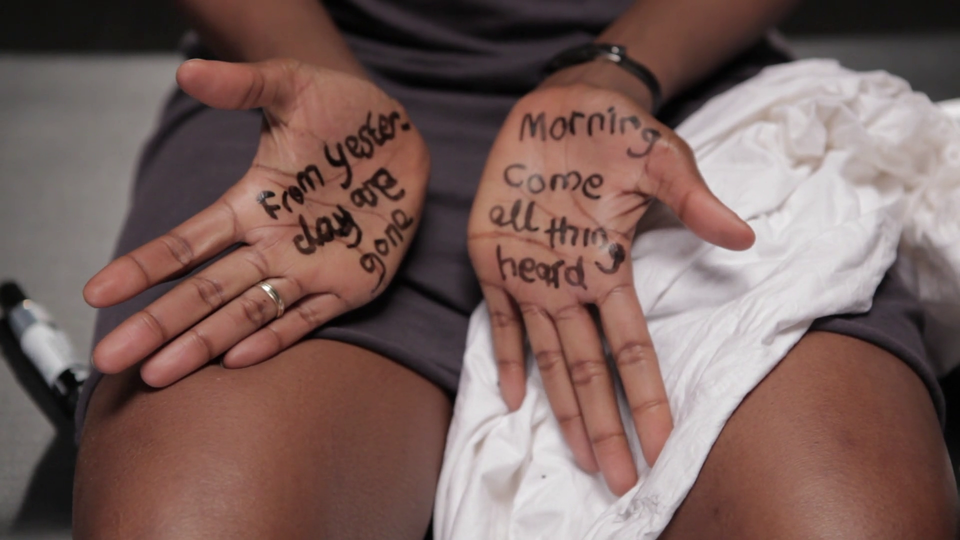
The song, often taken up as a protest anthem, was written in 1940 and expresses a vision of the United States as an egalitarian society. In Haloba’s exhibition, I first encountered it at the entrance to the Light Hall, where the artist’s rendition emanates from a speaker in the ceiling. As I move through the space, I realised the anthem forms the soundtrack to the video work I Want to Tell You Something (2010–11), screened at the back of the exhibition space. In the video, the artist writes words on her hands with a whiteboard marker before wiping them off with a white cloth. The text fragments are drawn from imagined conversations with figures such as philosopher Hannah Arendt (1906–1975), who is known for her criticism of the state. “I tell you these things and I wash them off me,” is one line. A trace of ink remains in the fine lines of her palm, which can be read as a metaphor for how words retain a presence even after they have been uttered.
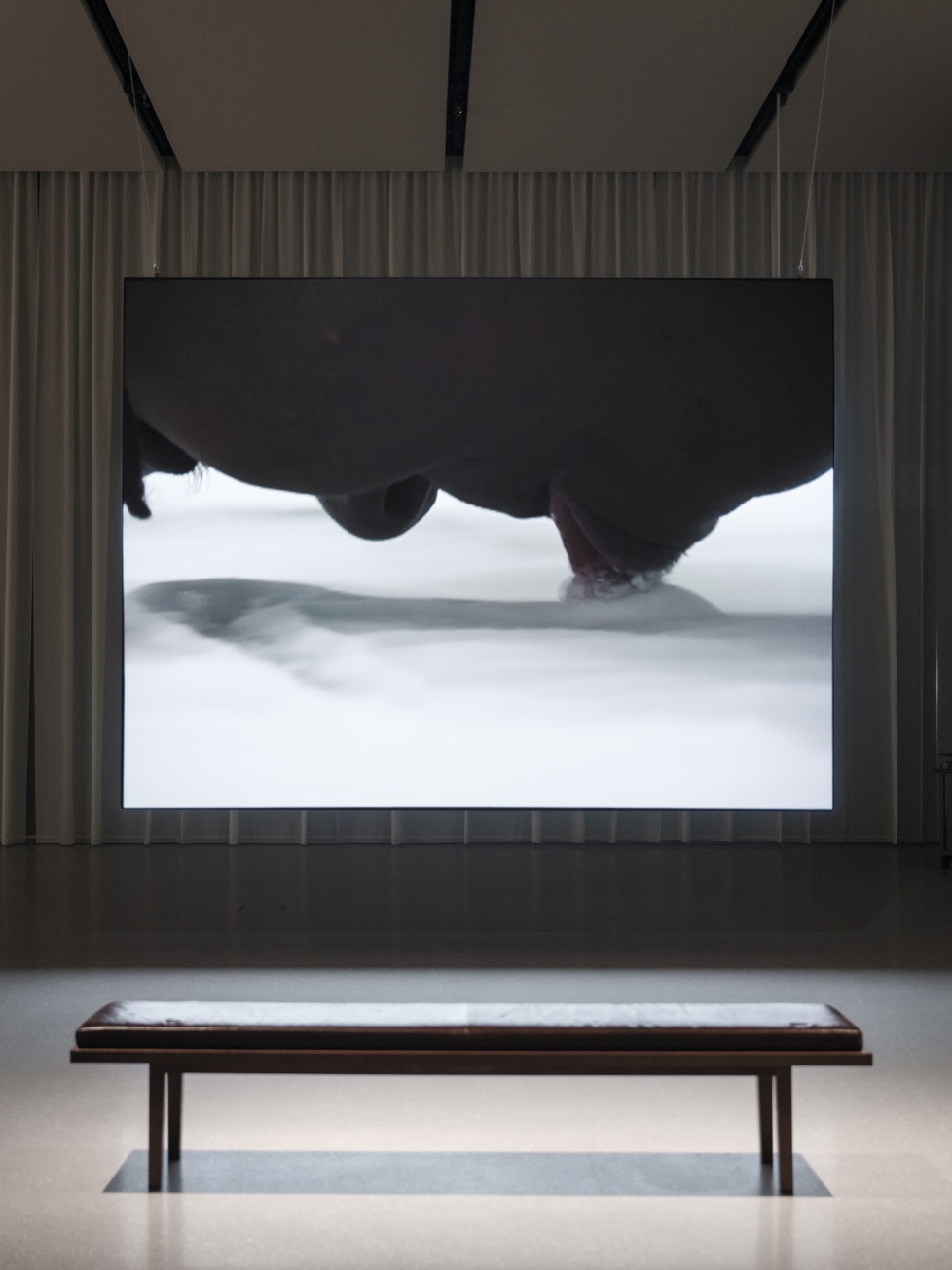
Hearing as a sense is also central to the experience of Lamentations (2006–2010). In the video, here projected onto a screen at the centre of the room, Haloba is filmed running her tongue across what appears to be snow, but is in fact salt. While watching, I could almost feel the sensation myself: the crackling rhythm that accompanies the artist’s movements sends a tingle along my tongue and up the back of my neck. Associated with wisdom and purification, salt is central to many religious and cultural practices. It also carries bodily connotations.
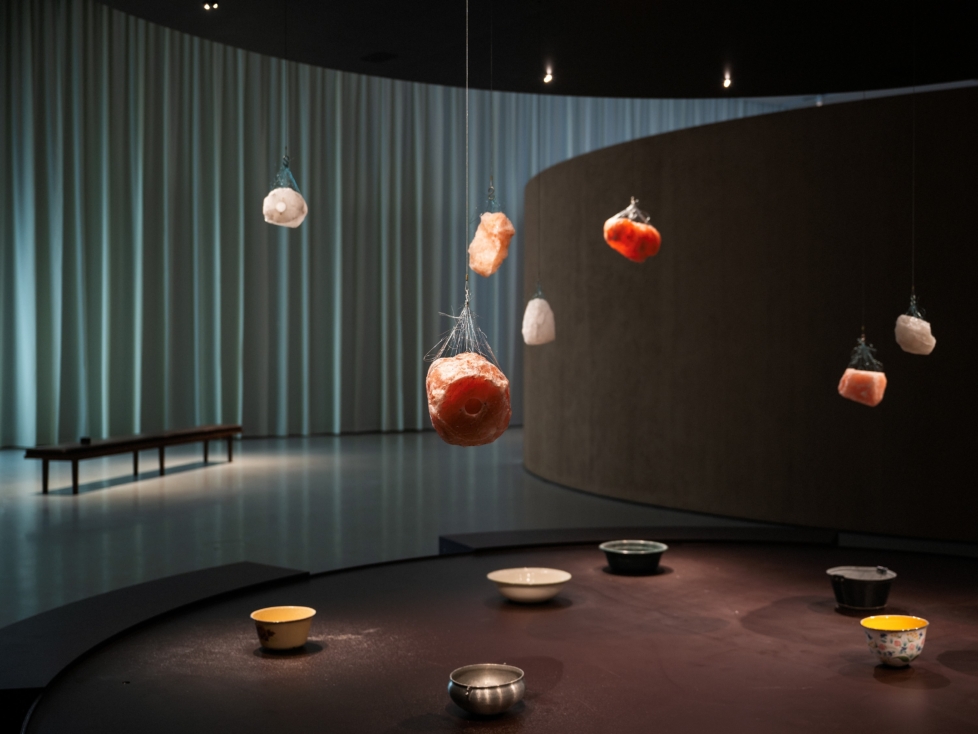
The fact that we both sweat and cry salt water is a theme reiterated in the installation Close-Up (2013–2016). Here, eleven salt blocks are suspended from steel wires attached to a circular ceiling above a raised platform. Like a body that is either warm or sad, the salt blocks drip water into bowls made of plastic, steel, and ceramic. The water and salt form circles on the floor, and when I visited the exhibition, some of the blocks had already developed deep grooves from the running water. The blocks will most likely split over the course of the exhibition, and they appear both solid and fragile at once. The liquid that drips into the bowls is accompanied by a soundscape in English, as well as in the African language Luyana and the South American language Guaraní. The words I can make out tell a story of struggling for and belonging to a piece of land – but also of forgiveness.
The installation was first exhibited at the São Paulo Biennial in 2016, one of several major presentations Haloba has had in recent years. She is currently exhibiting at Trondheim Kunstmuseum as one of the nominees for the Lorck Schive Art Prize, and in 2026 she will be the Festival Exhibition artist at Bergen Kunsthall. This summer, she took part in the Berlin Biennial with Looking for Mukamusaba – An Experimental Opera (2025), which is also on view at the National Museum.
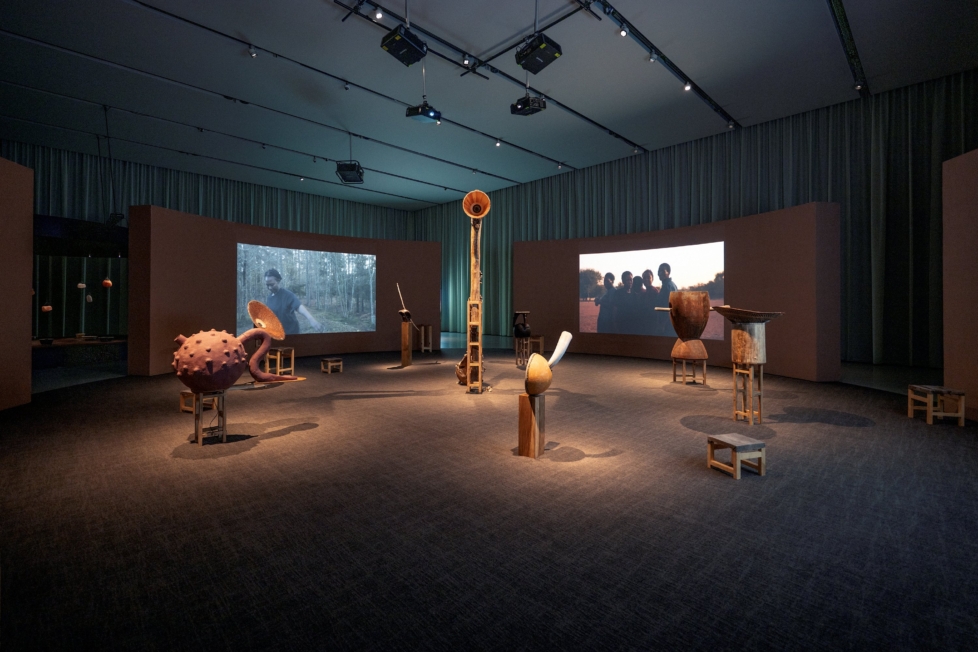
The opera is presented in a circular room with reddish, knotted walls at the centre of the Light Hall. Four videos are projected onto the walls. The images bleed into one another and depict, among other scenes, the artist dancing in a damp forest. Six women dressed in red and blue dresses also perform a kind of crowded collective dance before singing individually to the camera. These are elements taken from initiation rites in the Chiyabilo tradition of southern Zambia, according to the press release. The women’s voices cannot be heard, but the room is filled with sounds that emanate from eight sculptures assembled from everyday objects – including instruments, bowls, and other items made from natural materials – placed on wooden stools. Built-in speakers transmit the opera’s English libretto: different voices speaking with varying degrees of intensity and tonality about looking away from and excusing hunger, genocide, and sexual violence. Some of the voices are confrontational, and Haloba does not shy away from stark imagery. One of the singers, for instance, describes young girls struggling to urinate after having been raped – the reality for many in both Sudan and Palestine.
A large timber log topped with a wooden funnel stands in the middle of the space. A bellows covered in fabric and cowhide extends from the top of the log, with dozens of teabags attached to it. As I moved closer, I recognised the scent of cloves, but a sharp, repellent smell also hit me, possibly from the cowhide. The sculpture refers to Mukamusaba, a mythological, authoritative female figure whom Haloba has previously described as a revolutionary guiding force in her work. I imagined Mukamusaba listening to and condemning the erosion of humanity in the face of contemporary wars and conflicts; she also speaks, urging more people to acknowledge the “dignity of souls,” which I understand as the inherent worth of all human beings.
Mukamusaba also says: “You know the G-word is now applicable, but your mouths are full of bitter leaves.” There is something ironic about the museum exhibiting a work that addresses those who remain silent in the face of the ongoing genocide, at a time when the institution itself has spent recent months insisting on its neutrality on the matter. Perhaps Haloba, through her multisensory universe, can show us how the situation in Palestine forms part of a colonial history that stretches across centuries and continents, and how the pluralistic coexistence she proposes is rooted in principles of solidarity. Although the works are anchored in political questions, it was their phenomenological dimension that affected me most: the use of sound makes tangible the ways in which other unseen forces – traditions, myths, borders – become internalised.
Translated from Norwegian