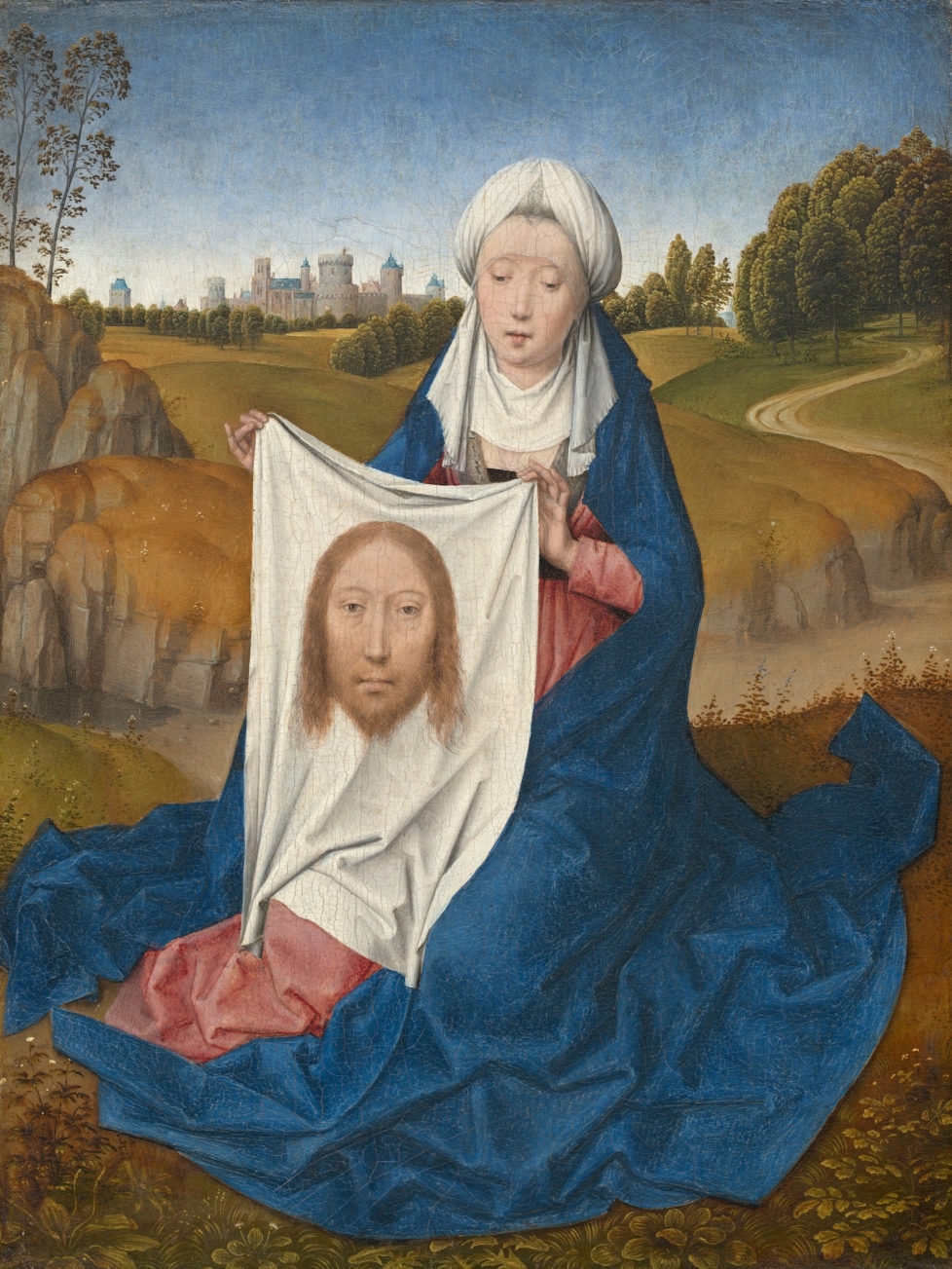
There is a particular category of images that continues to fascinate and puzzle me. I call them “showcase images.” The simplest definition is that they are images in which something, often another image, is being shown to the viewer and held up for scrutiny.
Over the years, I have built a small, unsystematic collection of this kind of image, often added to when friends send me new examples they have come across in an exhibition or a book. My digital archive contains some twenty-five images spanning the 15th century to the present, and I think it is fair to say that the collection came into being and grew during the years in which I taught at the Schools of Visual Arts at the Royal Danish Academy of Fine Arts in Copenhagen, from 2009 to 2020.
A good example of a showcase image is Hans Memling’s painting Saint Veronica from 1470–75, showing the saint with the sudarium known as her veil. Veronica presents the imprint of Christ’s face to us. She holds the cloth delicately between two fingers while looking down at it. Her expression is sorrowful and inward-looking, but it also carries a certain pride, perhaps in having this relic to show. The image itself, however – the imprint of Christ’s face – looks back at us calmly and insistently.
Quite apart from telling the story of the Veil of Veronica, Memling’s oil painting on panel is also an image of an image being shown. And the displayed image (the face of Christ on the cloth) holds our gaze and seems to say: “Trust me, I am about to tell you something important, something that cannot be told in any other way.” What is distinctive about showcase images is their insistence that an image can say something that only an image can say.
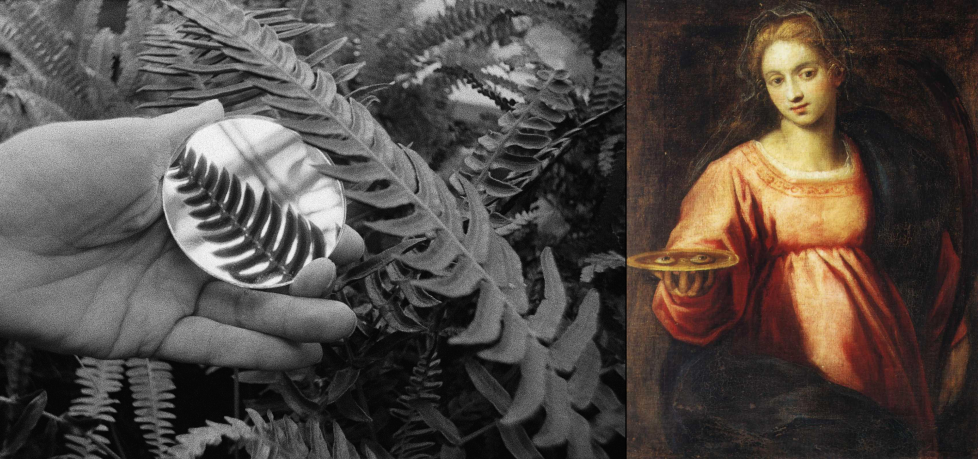
The showcase images in my collection are quite different from one another. A more contemporary example comes from the film Word for Forest (2018) by Pia Rönicke, who often uses hands displaying images in her work. In a still from the film, we see a hand extending a mirror, and through this intimate gesture we are shown the underside of a fern – something our eyes could not otherwise reach through the camera lens. Showcase images ask us, first and foremost, to look, but they also often show us something we would not otherwise be able to see, or something we overlook.
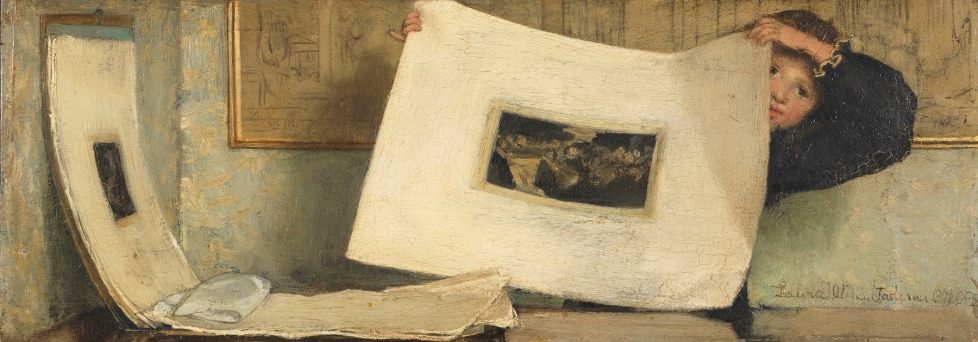
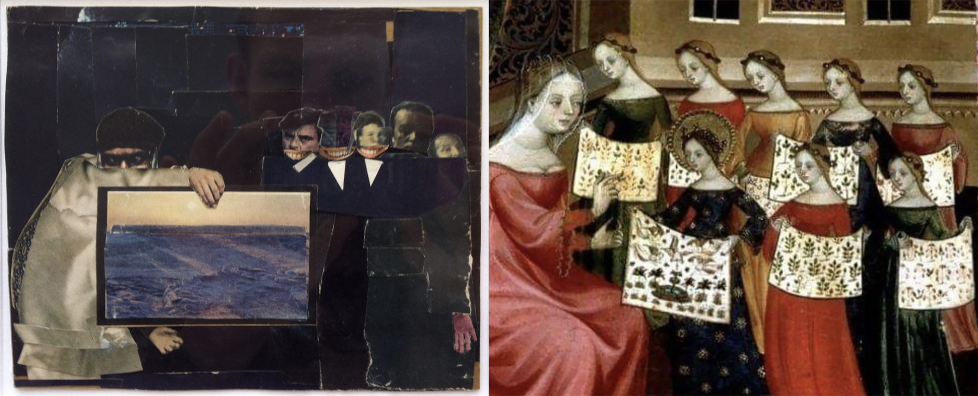
My collection includes a work even older than Memling’s painting: Lluís Borrassà’s altarpiece ca. 1390–1400, in Saint Francis Church in Villafranca del Penedès, Spain. It contains a particularly intriguing detail in which we see the Virgin Mary and her classmates dutifully showing their embroidery to their needlework teacher. The teacher studies their pictures with one hand raised and points to a detail in Mary’s embroidery that stands out. While the other pupils have embroidered patterns of plants and flowers, Mary has embroidered a fountain surrounded by five flying angels.
I like to think that some apprentice in Borrassà’s workshop had a blast painting in the needlework students’ motifs. The classroom scene and my own imagining of Borrassà’s apprentice both illustrate the old model of learning upon which the classical European art academies were originally structured: First the pupils learn to do as the master does, and later they go on to establish workshops of their own, with pupils of their own. Here, in Borrassà’s image, we see the moment in which Mary distinguishes herself and presents a work of her own.
This depiction of a needlework class, with pupils standing in a row, is far removed from the kind of teaching found at art academies today. For many people, what actually happens at academies probably remains something of a mystery. It may be easy enough to imagine that works are being made, that techniques are being learnt and tested, that forms of expression are being experimented with, and that thinking and doubting are part of the process.
But something else happens there too, something that will probably remain unseen by most people and yet is one of the most important things of all: Images are being displayed with the conviction that others will look at what is being shown with empathy and attentiveness. When I say “images,” I use the term in an expanded sense; images can take many different forms, including as a sculpture, a movement, a sound, a sentence, an installation.
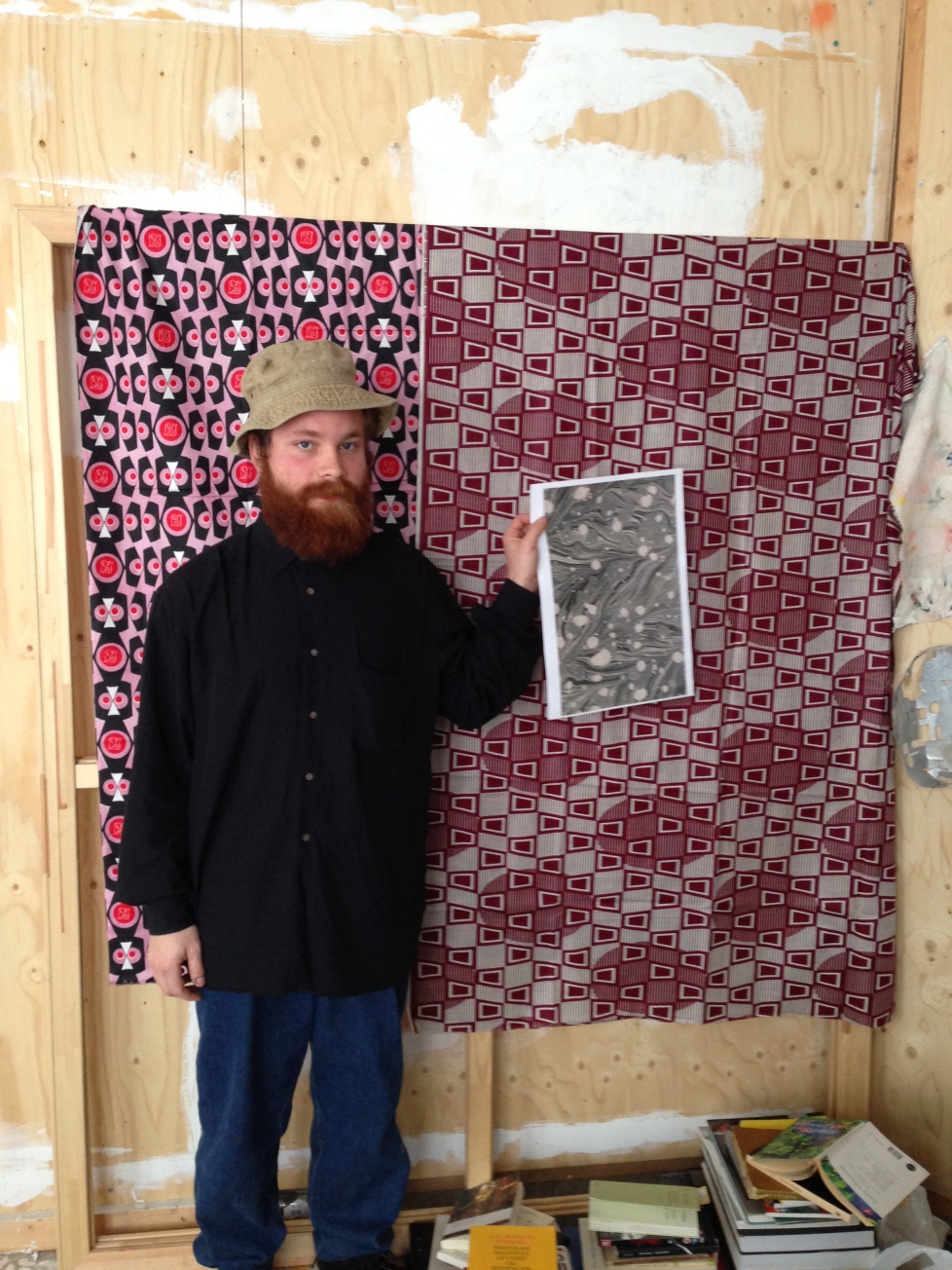
In conversations with my students at the academy, I was often reminded of these images of display. For example, I remember one student holding up a photocopy of a marbled pattern image from the novel Tristram Shandy in front of a patterned piece of textile draped over a stretcher frame standing behind him. The photocopy and the fabric complemented one another, giving rise to a third image. Or the time when, on my way down the stairs, I met a student who excitedly showed me her first 3D-printed sculpture. Our movements, hers upwards, mine down, paused for a brief moment, and there, in the middle of the staircase, we both stood looking at the figure in her hands. I knew how much work it had taken to get there, and she knew that I could see it. There was not much more to say.
I could give many more examples of moments like these. They are difficult to describe in an official syllabus, and yet they form the essence of the visual exchange that takes place back and forth between students and teachers. That exchange of images, ideas, knowledge, moods, and ways of being in space underlies everything and is among the most indefinable things that happen in an academy.
An image of display will always have a pair of hands presenting something to us, asking us to look closely. You could say that hands are an integral part of the criteria for my collection. There is nothing pleading or submissive about these outstretched hands. On the contrary, they radiate a belief that what is being shown matters, that it is important, and that using images as a form of communication has special power. That insistence and that appeal for focus and trust is an essential part of what we are being asked to look at.
Besides the hands, these images also often include a room, a landscape, a situation surrounding what is being shown. The displayed object needs a carefully chosen context in order to establish and sustain the trust in which images thrive best. At the same time, the act of display also adds value and significance to what is being presented. When friends send me new images of display, or when I look again at those I have gathered myself, it is this attribution of value to images in and of themselves that fascinates me. The outstretched gesture that says: “I am showing you this because it matters.”
– An earlier version of this essay was published in the BFA catalogue of the Schools of Visual Arts at the Royal Danish Academy of Fine Arts, Copenhagen, 2018. Translated from Danish.