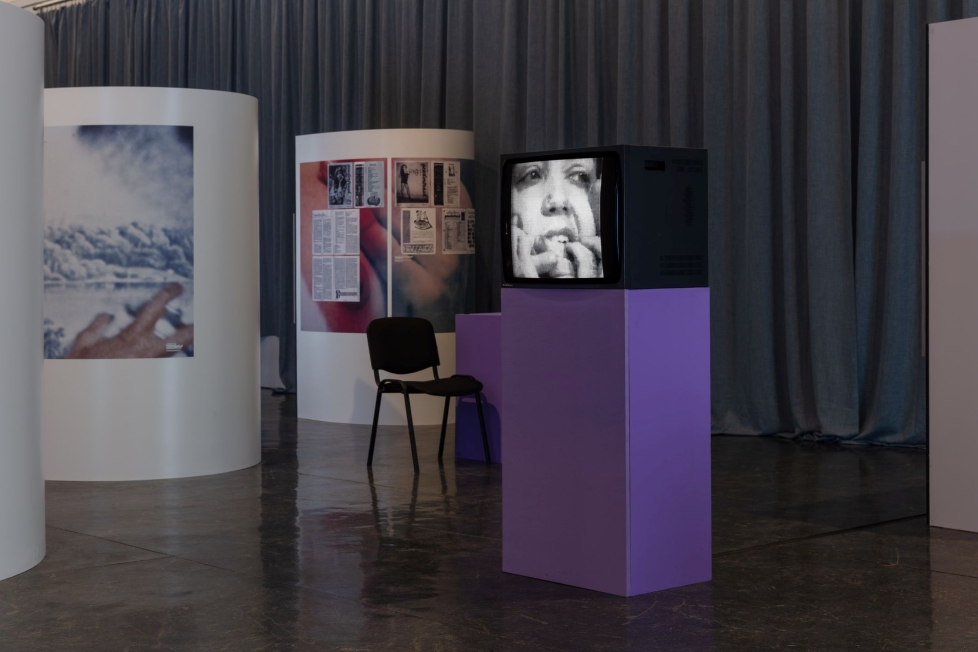
“So much I want to say” – the words are repeated, like a broken record, in So much I want to say by Mona Hatoum from 1983. The phrase is uttered monotonously, matter-of-factly, almost without emotion, as if addressed more to herself than to any listener. It is like a metronomic exercise. The words fill the space and create, more or less intentionally, a backdrop or a point of departure for the viewer before putting on the designated headphones. “So much I want to say” is the only phrase present, and the only audible soundtrack in the exhibition, which must be experienced individually through headphones. In this context, it can be read as a statement. But a statement of what, exactly?
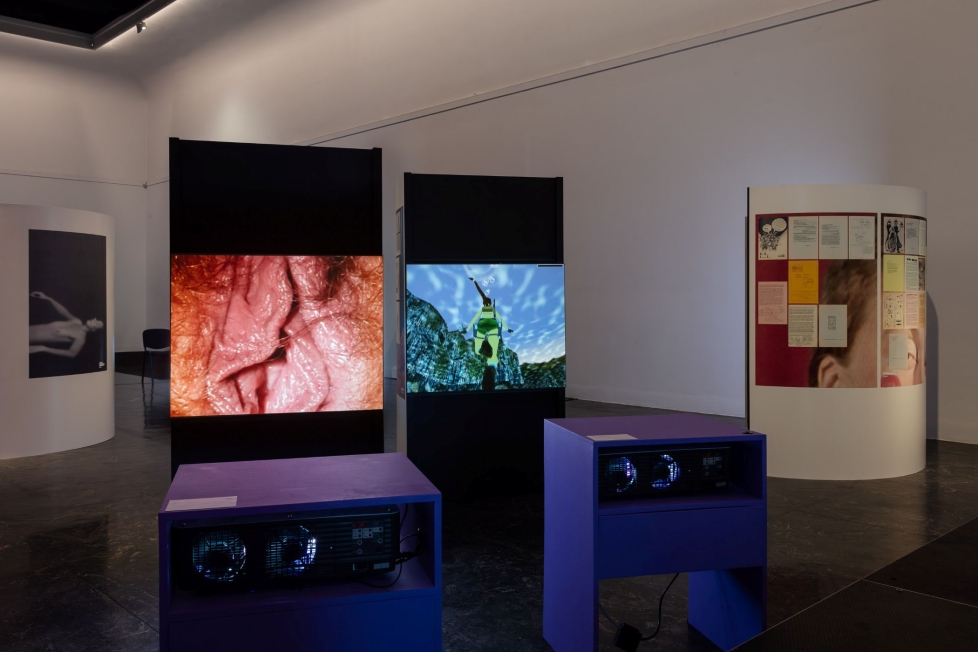
No Master Territories: Feminist Worldmaking and the Moving Image is an ambitious exhibition. It comprises around forty films and videos, supplemented by photographs and documentation by women artists and filmmakers from different parts of the world, with a particular emphasis on the period from the 1970s to the 1990s. First presented at Haus der Kulturen der Welt in Berlin in 2022, the exhibition emerged from a long-term research project. This iteration at Kunstnernes Hus includes a small number of additional films relevant to the Nordic region and, more specifically, Norway. The scope is considerable, yet the selection also raises a question that follows the viewer through the galleries: What is lost when such an extensive body of work is compressed into a single exhibition, and what is made visible? The curatorial gesture that already signals this tension is the fact that all the works are presented in digital form, while the original display formats are indicated only as reference.
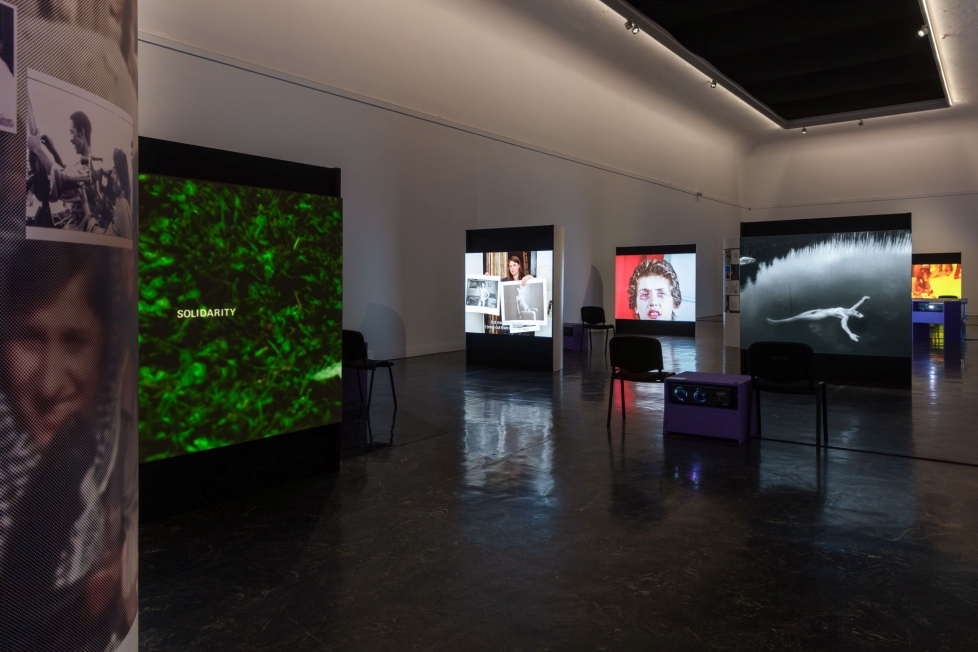
The way the films are presented – as a constellation of sculptural screen structures dispersed throughout the space, without partitions or other forms of separation, allowing the viewer to move freely and without a fixed chronology – is a deliberate choice. To conceive of film as a spatial medium rather than a time-based, linear presentation has consequences. Different elements of the filmic experience unfold simultaneously, and it is the viewer who constructs the narrative and meaning through their own choreography within the space. The exhibition plays with elements such as duration, projector light, and film colour. In a conventional film screening, the viewer sits in silence in a darkened room for a set time; once the film ends, they move on. Here, time is either as linear or as fragmented as the viewer makes it: some films are seen, others less, and some perhaps not at all. Individual frames may also be experienced in isolation or in interplay with other projections, opening up more complex visual encounters.
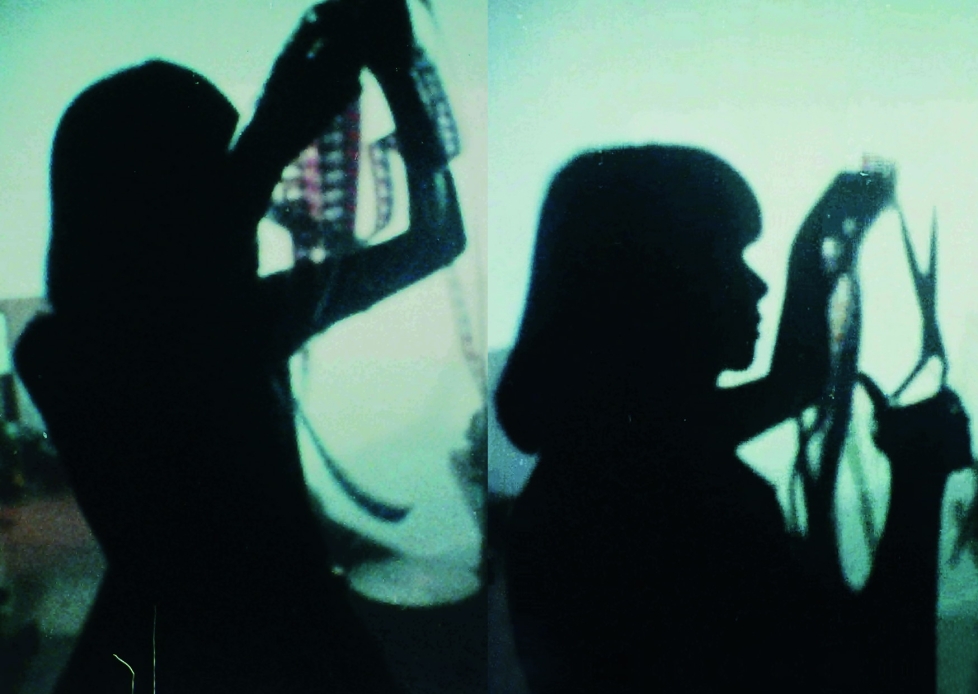
This strategy is particularly compelling in No Master Territories since the screen, whether physical or projected, is treated seriously as an object to be integrated into the exhibition architecture. The exhibition thus avoids what often characterises moving image works in gallery spaces: a screen on the wall, one on the floor, and one in a room entered through a curtain. In this case, it is not the installation architecture that frames the films; the films themselves have become the architecture, the constellation, the installation.
Although the exhibition presents a wide range of films – in varying forms and styles, by makers from different geographical contexts – many of them nevertheless revolve around overlapping motifs, all connected to women’s struggles and feminist experiences. But first: a few words on the context for filmmaking in the 1970s up to the 1990s.
Those with a background in film and feminist studies can scarcely avoid referring to Laura Mulvey’s 1975 essay ‘Visual Pleasure and Narrative Cinema’. In the essay, she introduces the concept of the male gaze and the idea that classical Hollywood cinema addresses a spectator assumed to be male, with the woman positioned primarily as a visual spectacle for his gaze – an object rather than a subject. This is a phenomenon that many female directors and independent filmmakers have since sought to deconstruct through various strategies. From a wide film-historical perspective, you might say that the 1970s largely drew on documentary realism and avant-garde strategies. In the 1980s, feminist film studies became more institutionalised, while new discussions around intersectionality emerged (one could think, for example, of the films of Julie Dash). In the 1990s, in the wake of third-wave feminism and movements such as New Queer Cinema, these perspectives further expanded to include postcolonial critique – at the same time, women gradually became more represented in mainstream film production.
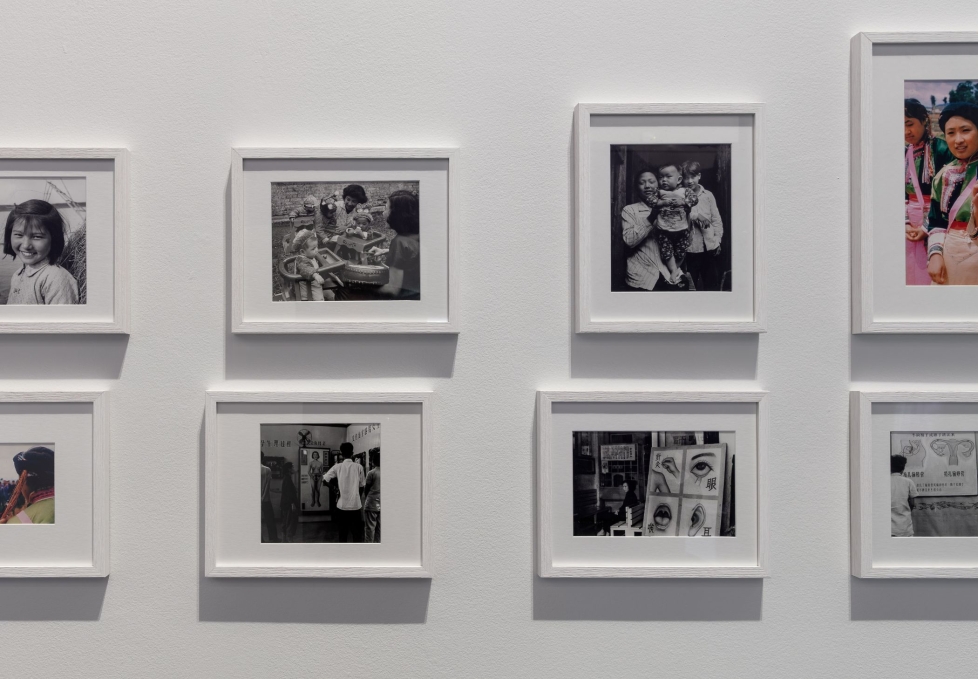
Frequently mentioned filmmakers from this period include: Barbara Kopple, Yvonne Rainer, Agnès Varda, Chantal Akerman, Margarethe von Trotta, Helke Sander, Suzana Amaral, María Luisa Bemberg, Ann Hui, and Aparna Sen. Of these major figures, only Varda appears in the exhibition, and is represented by lesser-known works – namely, documentary photographs of women from the People’s Republic of China (1957). Despite significant formal and stylistic differences, certain shared concerns nevertheless emerge in the exhibition: an attentiveness to women’s inner lives and dignity, the body as a contested territory, and the home as a political space. Akerman’s Jeanne Dielman, 23 quai du Commerce, 1080 Bruxelles (1975) is a canonical example: three hours dedicated to a woman’s repetitive domestic labour – with long takes, anti-narrative structures, and minute detail. Themes such as memory, identity, and resistance to male-dominated narrative conventions recur, and many of the works inhabit the tension between operating within existing structures and attempting to dismantle them. Such concerns are also foregrounded in No Master Territories.
Female sexuality, the body, and expectations tied to gender ideals recur across the selection of works. In We Aim to Please (1976) by Robin Laurie and Margot Nash, we follow – with a generous dose of humour – a conversation between two friends about their relationships to their own bodies. The conversation is accompanied by close-ups of body parts, notably an image of red-painted lips with imperfect teeth filling the entire screen, a motif that lingers. At one point, it struck me that the video could be read as an ironic response to Vito Acconci’s Open Book (1974), a video in which we see only a close-up of the artist’s mouth, held open throughout as he attempts to speak. A more pragmatic approach to bodily representation appears in Aktfotografie (Nude photography, 1983) by Helke Misselwitz, in which the photographer Gundula Schulze Eldowy describes breaking with the convention of concealing the model’s imperfections. The film is presented alongside photographs from Schulze Eldowy’s series Aktportretter (Nude portraits, 1983–1987), in which ordinary women adopt natural poses in domestic settings.
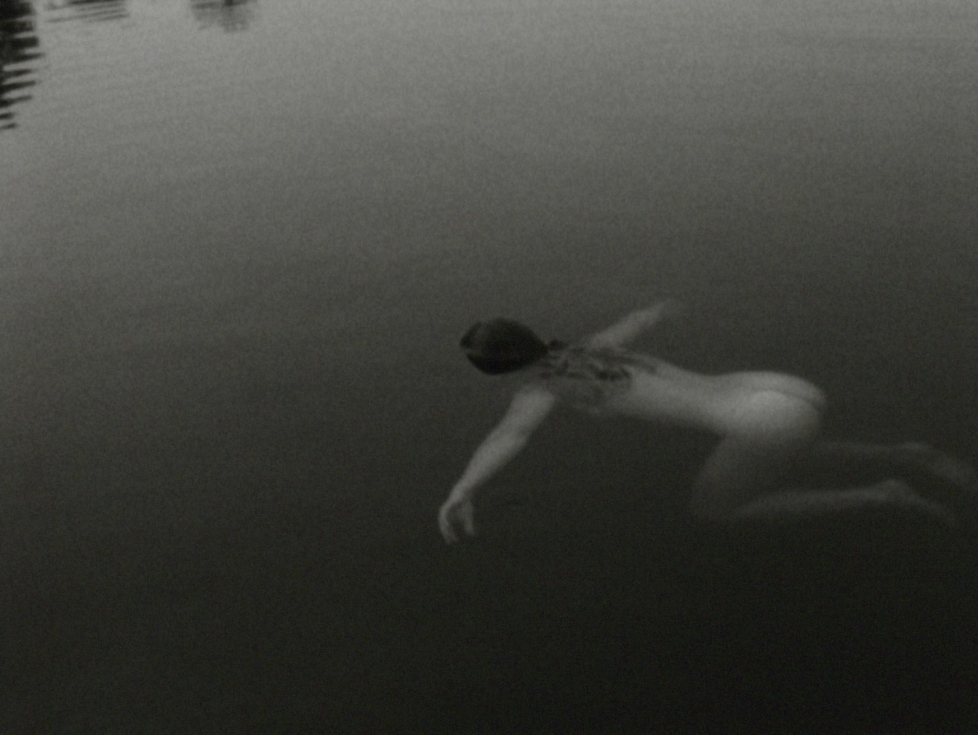
The exhibition also makes space for direct representations of female sexuality without a clearly defined male or medical framing. In Near the Big Chakra (1971) by Alice Anne Parker, we see close-ups of thirty-eight vulvas presented in a matter-of-fact, demystifying manner – occasionally, a tampon string is visible. A more explicit depiction of sexual fantasy appears in Between (1989) by Claudia Schillinger. The exhibition also encompasses more ambivalent expressions: in Onanism (1969) by Nalini Malani, the artist lies alone on a divan, twisting and turning; it is difficult to determine whether the movements convey pain or ecstasy. Other works operate in a more subtle and aesthetic register. Female bodies reminiscent of Ophelia figures float in water in Kvinnorna vid Tjursjön (The Girls at Bull’s Pond, 1993) by Tuija Lindström, while Running (1988) by Ingrid Karlsen depicts the artist running in circles, again and again – persistently, almost meditatively.
The exhibition also includes a number of works that address patriarchal structures and their consequences in everyday life. Some do so with irony, as in Helena Amiradżibi’s Kobieta to słaba istota (The weak woman, 1967), a quasi-documentary work in which various women speak about their domestic obligations while the men sit in front of the television reading the newspaper. A similar displacement of the everyday can be found in Tarefa I (Assignment I, 1982) by Letícia Parente, in which the artist uses her own body as an object: she hangs in a wardrobe like a garment or lies on an ironing board while another person passes an iron over her.
A confrontational tone characterises Popsicles (1982–1984) by Gloria Camiruaga, which turns its gaze towards both the power of the Church and the military. While reciting the Ave Maria, women and girls lick popsicles which are gradually revealed to conceal small toy soldiers. Contrast is also employed as a device in Miss Universe in Peru (1982) by the collective Grupo Chaski, in which images of beautiful women and beauty advertisements are set against the faces of ordinary women and footage from a congress of the Peruvian Peasant Confederation. It reflects on how global capitalist ideals shape notions of femininity.
A few of the works address specific experiences of violence. Krisesenteret i Oslo (The Oslo Crisis Shelter, 1980) by Inge-Lise Langfeldt allows women who have sought refuge to share their stories. The film contributed to the establishment of similar shelters for women affected by domestic violence in Denmark and Sweden. The theme is addressed more indirectly in the stop-motion animation Prowling by Night (1990) by Gwendolyn, which takes up sex workers’ experiences of police harassment in Toronto.
Labour and working conditions form another recurring motif. In Serpent River (1989), Sandra Lahire examines the consequences of uranium extraction. In Mi aporte (My contribution, 1972), Sara Gómez interviews Cuban factory workers. Male workers claim that their female colleagues cannot work as hard as they can; these sections are juxtaposed with sequences exposing structural issues in the workplace, such as the absence of childcare and inadequate support for pregnant workers. Solidarity (1973) by Joyce Wieland presents a poetic view of labour struggle. A strike is documented through an unusual device: the camera shows only the participants’ feet and shoes, while the word ‘Solidarity’ appears at the centre of the screen.
Several works function as documents – or documentary forms – of women’s struggles. Ana Victoria Jiménez photographed a demonstration for the right to legal abortion in Mexico in Protesta por el aborto (Pro-choice demonstration, 1977). Lisbeth Dehn Holgersen documented a 1971 demonstration in Copenhagen demanding equal pay for women in Vi kræver ligeløn (We demand equal pay, 1972). The exhibition also includes footage from the first international women’s film seminar in 1973, filmed by Vibeke Løkkeberg.
I come full circle and return to Mona Hatoum. On the monitor, we see a close-up of her face; a man’s hands hold her mouth shut, preventing her from speaking, as the audio recording of the words “So much I want to say” plays on a loop. Although the exhibition foregrounds different geographies and the absence of a clearly defined centre, many of the recurrent themes and experiences nevertheless have much in common – without losing the nuances associated with intersectionality.
I read the exhibition as an open research project, a body of work that can continue to evolve over time and be extended through new films and voices depending on the context in which it is shown next. There remain many women’s perspectives we barely know. Seen from the present moment – when the Jeffrey Epstein case continues to shape public discourse, when the Gisèle Pelicot case has contributed to shifting social understandings of sexual violence, when women’s rights are facing a new wave of backlash, when women remain disproportionately affected by violence, and when the consequences of climate change impact women to a greater degree – there is still much that needs to be said. Unfortunately, there is still much that women cannot say and are compelled to remain silent about. “So much I want to say” can thus be understood both as a curatorial and research proposition – a desire to bring forward diverse, not necessarily well-known voices – and as a statement addressed to the reality we continue to inhabit.
Translated from Norwegian.