For Catherine Christer Hennix (1948–2023), the ideal exhibition was one that was never taken down, an installation to respond to over and over. It is a fun thought experiment to apply this idea other shows, and to consider the extent to which encounters with contemporary art today are centred around the thrill of experiencing something new. For Hennix’s retrospective at Malmö Konsthall, the exhibition period is the usual couple of months, but I try to approximate her vision and visit it three times during the opening weekend. This is partly due to one of the works malfunctioning, but also because Hennix’s oeuvre doesn’t offer any easy entry points.
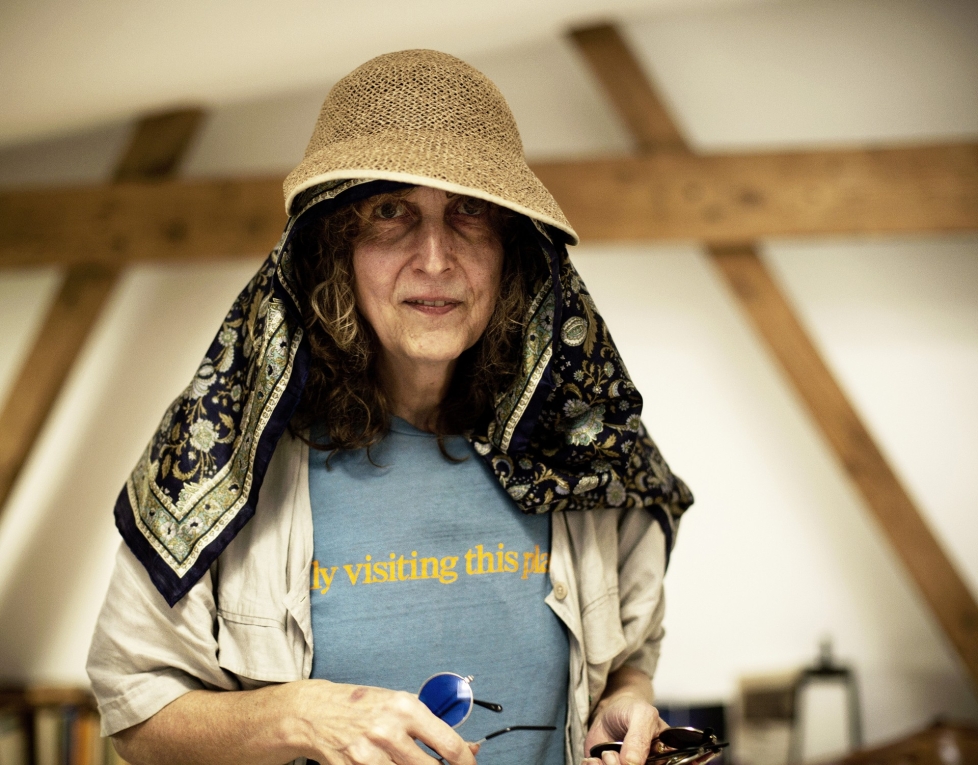
As a child, Hennix was introduced to music by her mother, Margit Sundin-Hennix, who was a jazz composer, and came in contact with many of the jazz luminaries passing through Sweden. Hennix was an early member of the Elektronmusikstudion in Stockholm, and in the late 1960s she travelled to New York, where she quickly became part of the avant-garde scene and met John Cage, Walter De Maria, La Monte Young, and others. Her university studies included mathematics and linguistics in the US and Sweden.
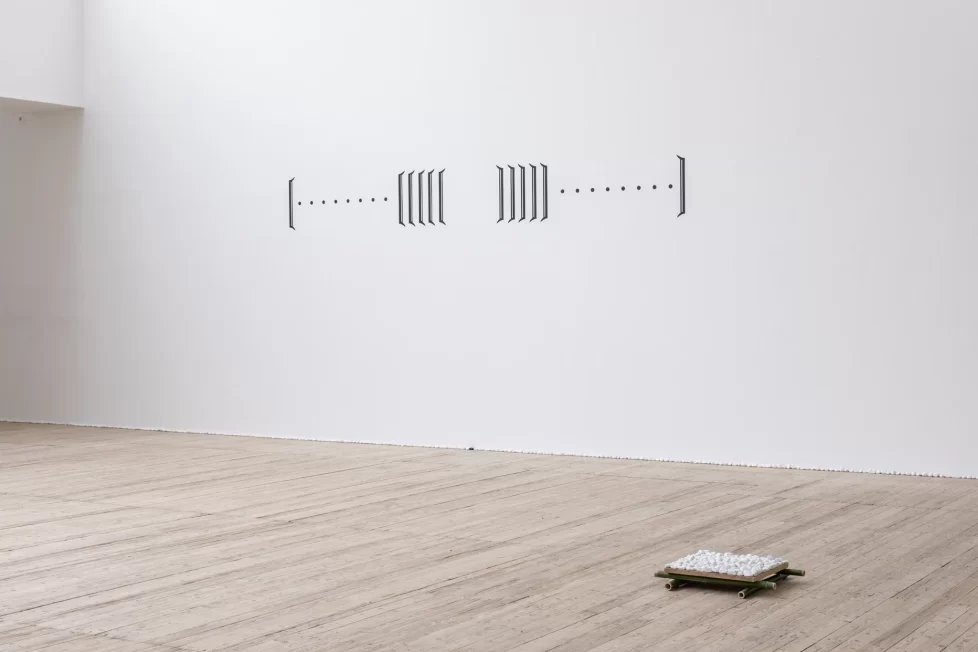
This is Hennix’s first major presentation in Sweden since her 1976 show at Moderna Museet, and part of that exhibition is recreated here in the form of a room with graphs composed of LED lights, wall paintings, a projection, and a droning sound environment. On the floor next to the wall are Brackets (1976/2026), steel sculptures in the shape of parentheses, as if they were delimiting something invisible to be put in relation to something else, a mathematical relationship that often seems relevant in this artist’s work. Some works interlock like factors in a multiplication, but then there are big leaps, which the parentheses seemingly represent.
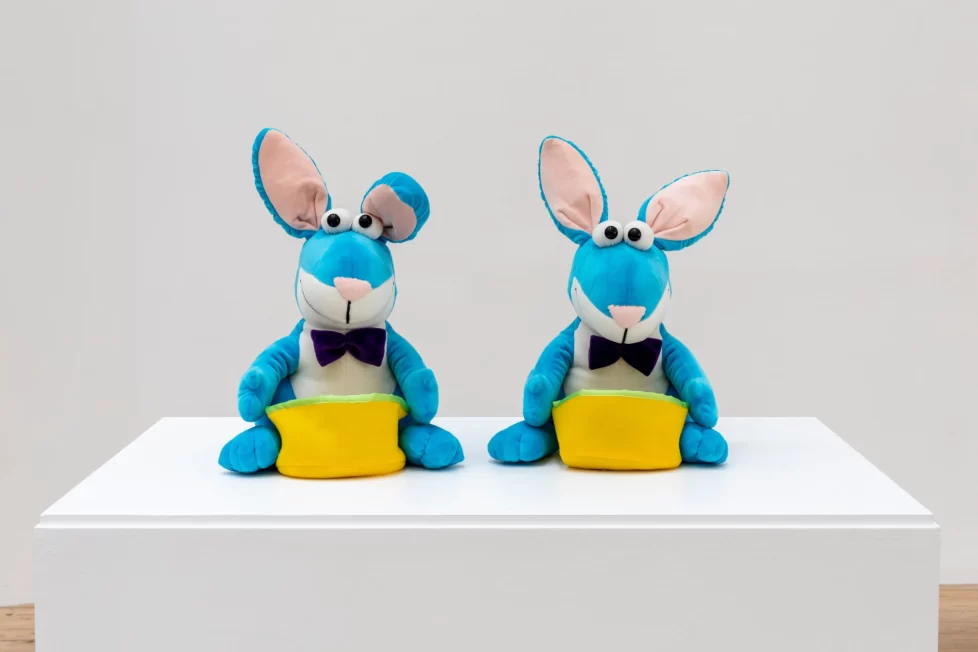
Despite the variety of media – there are paintings on paper, grainy black-and-white video, drone music, projections, mathematical formulas, stuffed animals, and pornography – everything in the exhibition is interconnected. It doesn’t amount to a distinct visual world to be enveloped by, but rather a parallel universe characterised by esoteric exploration. At times, it feels as if I have fallen into someone’s cryptic notebook.
Near the entrance, for example, there are three lines of black characters on a wall, Fragments from a Writing of the Unconscious (1994–95). It is illegible, even at the level of a Rorschach test. The large Möbius Strip (One-Sided Orientable Surface for Henry Flint) (1993/2026), hanging from the ceiling nearby, offers a clue: in this universe, there is no beginning or end, no correct order in which to move.
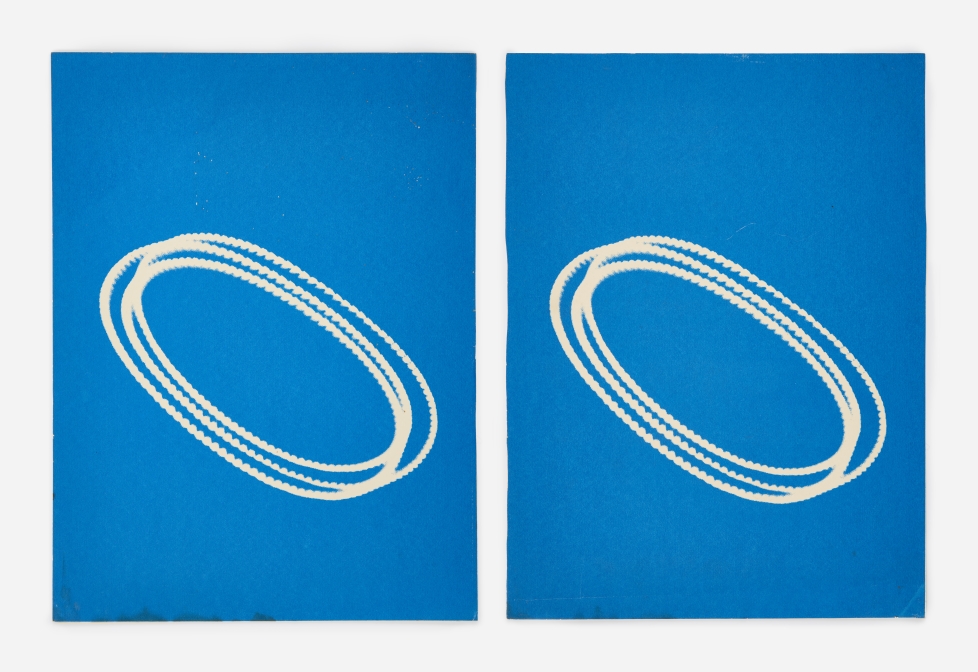
The exhibition is made in collaboration with the American non-profit Blank Forms, whose director, Hennix’s longtime collaborator Lawrence Kumpf, has been working with the konsthall’s curatorial team. The aim seems to have been to get as close as possible to the artist’s original vision. For example, the trans-pornographic material, two photographs on red and blue backgrounds displayed on a rear wall behind warning signs, would have been difficult to show like this – without explanation – in a museum context. With more knowledge about the artist, who transitioned in the late 1980s, the photos appear as one of the more personal elements of the exhibition, a statement about the importance of this being allowed to exist and be seen.
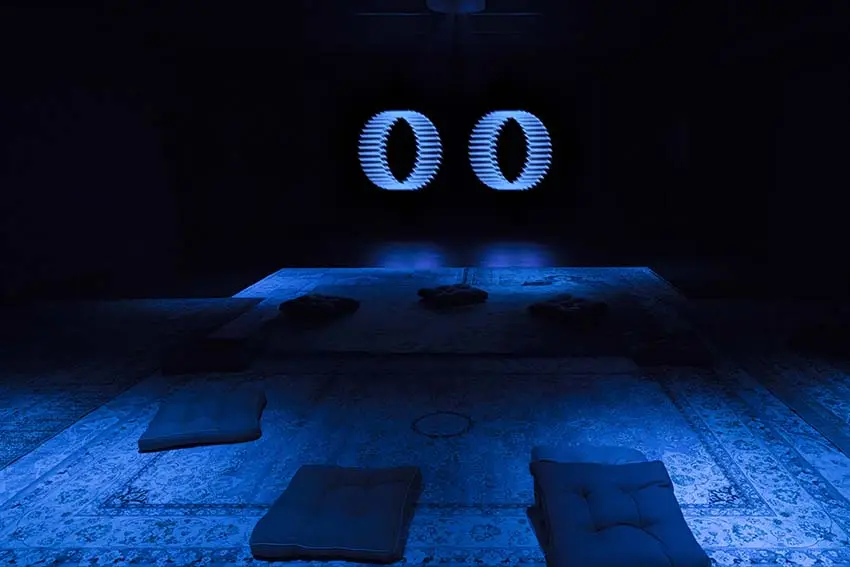
In the installation Nur (For Marian Zazeela) (2003–2018), a monotone composition plays at high volume and two blue, rotating cylinder shapes project onto the wall. As I sink down onto a soft carpet in the pitch-black room, it feels like something is roping me in for the first time. Immersed in sound, I fix my gaze on the projection and feel temporarily embraced. If this were a permanent exhibition, I would return.
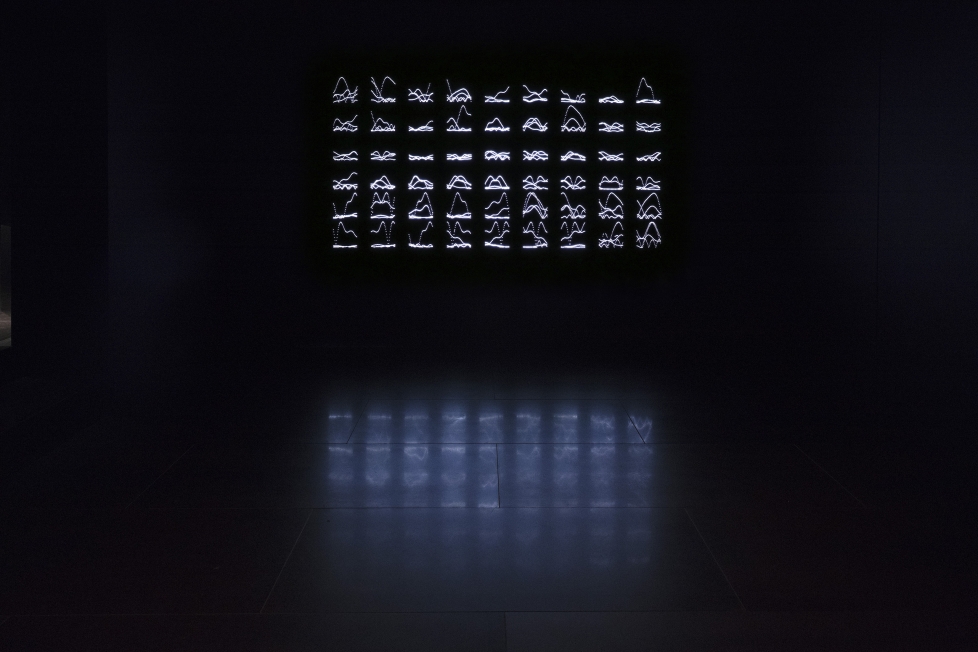
The monotonous sound of Nur echoing throughout the gallery was also something Hennix constantly listened to as part of her daily life. The fact that the exhibition staff need to wear earplugs illustrates an uncompromising attitude that is also expressed in the first sentence of Kumpf’s catalogue essay: “For the uninitiated, there are few points of entry to the hermetic installations of Catherine Christer Hennix.”
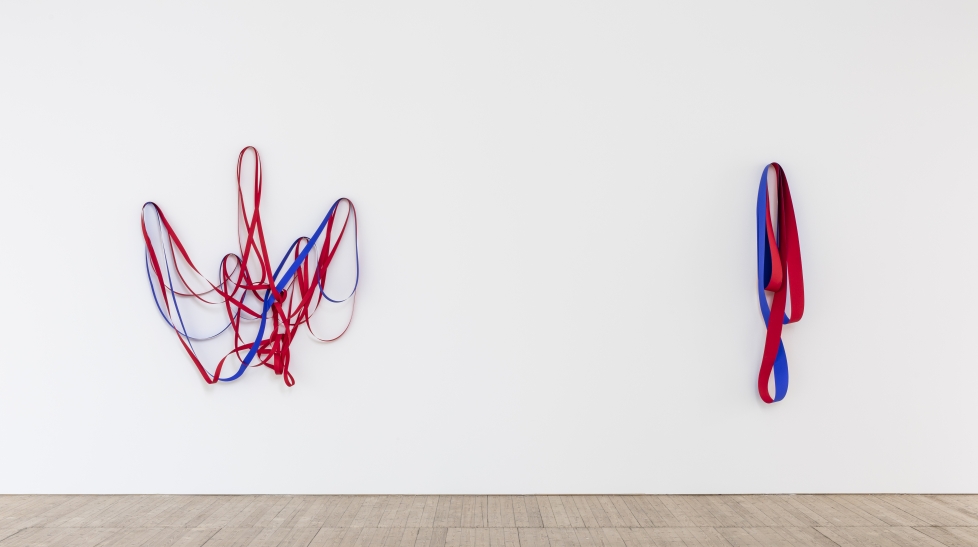
There’s something to say for not compromising on the ideal of an art free from didacticism. And perhaps it is just as well that there is no wall text attempting to explain advanced mathematics or French psychoanalyst Jacques Lacan’s theories on gender (which inform the many red and blue elements in the show). In her publication Notes on Toposes and Adjoints (1969–76) – an excerpt is included the exhibition – Hennix writes that “No fixed meaning can seriously be claimed for works of art or any other symbolic activity.”
However, at Malmö Konsthall Hennix is portrayed as unnecessarily mysterious. For example, I would have liked to know more about her interest in Sufism, which led her to convert to Islam and move to Istanbul later in life.
She often spoke about the difficulties of working with sound in the way she wanted to. Her first album wasn’t released until 2010, but limiting the duration of sound, when it should ideally have no beginning or end, was an anomaly to her. In a conversation from 2001, published by Blank Forms, interviewer Marcus Boon says that it still sounds like there was some institutional support for what she was doing until the end of the 1970s. Hennix straightforwardly replies that the support came from her mother, who financed the concerts.
Hennix seemed to have felt rejected by her birth country and complained in an interview published in 2020 on the Substack Tone Glow about how boring the Swedish cultural scene of the 1970s was, with its one-sided enthusiasm for alcohol and Marxism. It strikes me that this relaunch of Hennix is particularly timely, not primarily because of a renewed interest in Minimalism or electronic music, but because of the current spiritual resurgence. The fact that the exhibition plays to this is a side effect of the curatorial choices, but Hennix’s esoteric and introverted traits have undeniably religious dimensions.
It remains to be seen how many visitors will be “initiated” into Hennix’s practice at Malmö Konsthall. Perhaps the best chance would be at one of the concerts organised during the exhibition period. But I also get the feeling that the only way to truly understand Hennix would have been to become her disciple. All things aside, that’s an unusually high bar for an artist.